


This is a subscriber-only companion piece for AI Citation Ranking Factors. If you haven’t read it yet, I encourage you to start there.
This represents the next step: when we understand which features are associated with AI citations, how do we put this into practice?
Earning AI citations is mostly good SEO, with a few extra steps. Based on our database of case studies, experiments, and other evidence, there are a number of steps you can take to increase your chances of winning AI citations. You want to:
Make your content accessible to AI engines
Rank for the main query
Find and target fan-out queries
Choose the right content format
Match the answer to the query
Put your primary answers at the top
Make the page easy to cite
Important: You should understand that AI citations are probabilistic and aren’t as stable as traditional search results. AI citations change often, even day to day. The goal is not to permanently “win” AI citations, but to increase your chances of appearing over time.
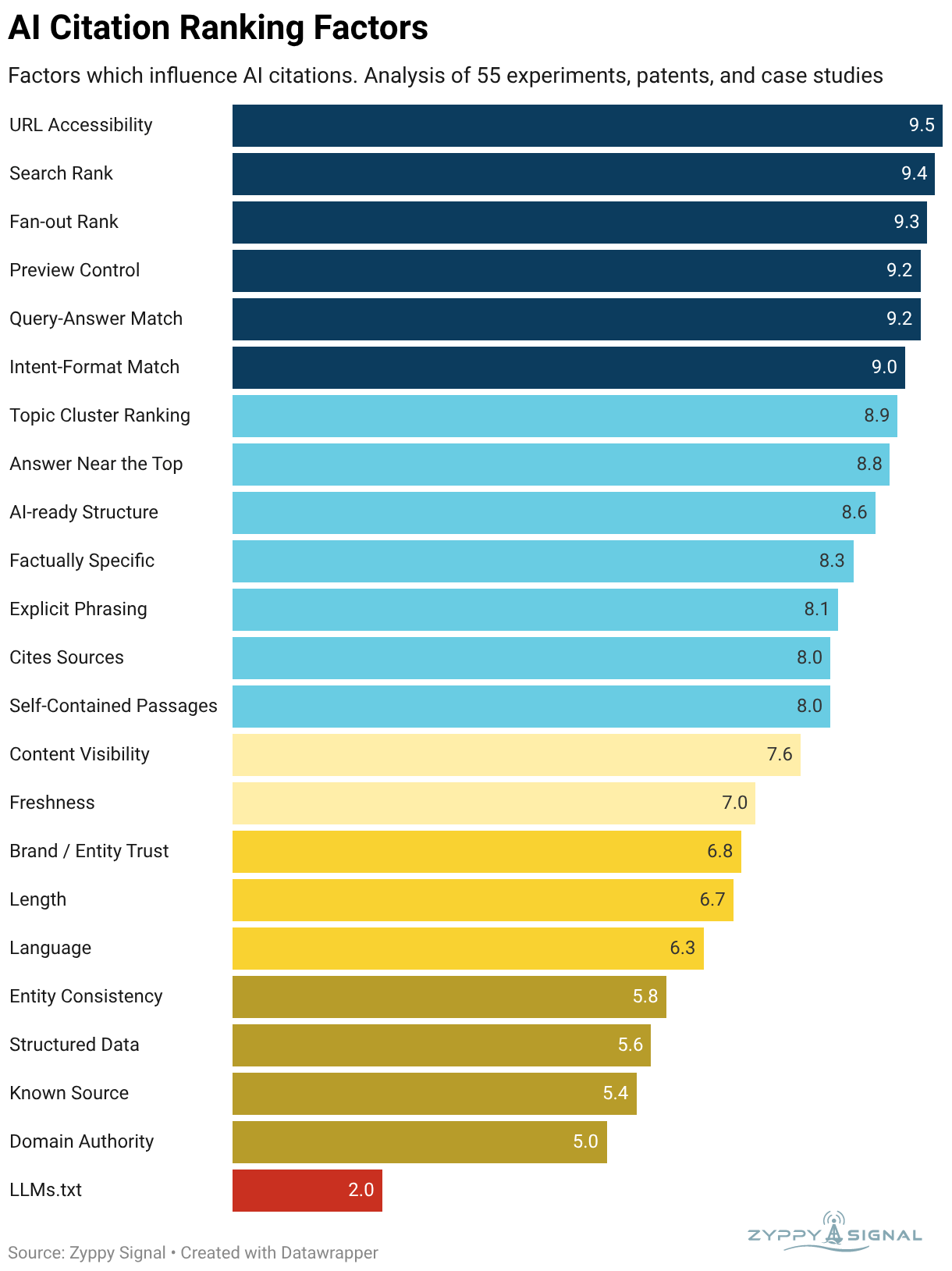
For review, here are the AI Citation Ranking Factors.
Step 1. Make your content accessible to AI engines
Making sure AI engines can access and read your content is more about what you don’t want to do:
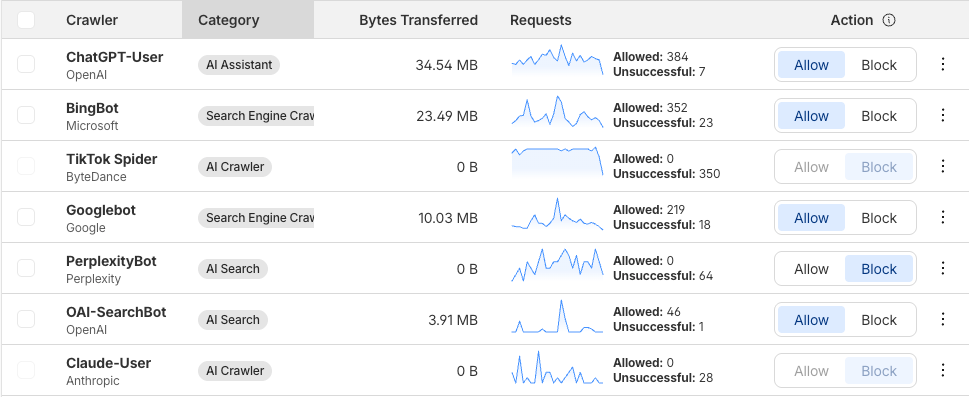
A. Don’t block important crawlers in your robots.txt file. For AI citations, the most important user agents are:
GooglebotbingbotOAI-SearchBotChatGPT-UserPerplexityBotPerplexity-User
If you use a platform like Cloudflare, you can review your AI Crawl Control to check which bots you may be blocking.
B. Don’t use tags that prevent search engines from displaying important content
The following meta tags can all prevent search engines such as Google and Bing from displaying and otherwise using your content in AI answers and citations:
<meta name="robots" content="noindex"><meta name="robots" content="nosnippet"><meta name="robots" content="max-snippet:0">
At the text level, the data-nosnippet attribute can also prevent content from appearing in AI answers.
<span data-nosnippet>Important text here</span>
C. Don’t rely on client-side JavaScript to render important text
LLMs like ChatGPT generally digest pure HTML, and even Google is known to encounter problems with JavaScript from time to time.
If your site relies heavily on JavaScript, use server-side rendering or another solution to deliver rendered HTML to the browser.
Use this LLM Content Visibility Scanner by Lily Ray to see if LLMs can access your content.
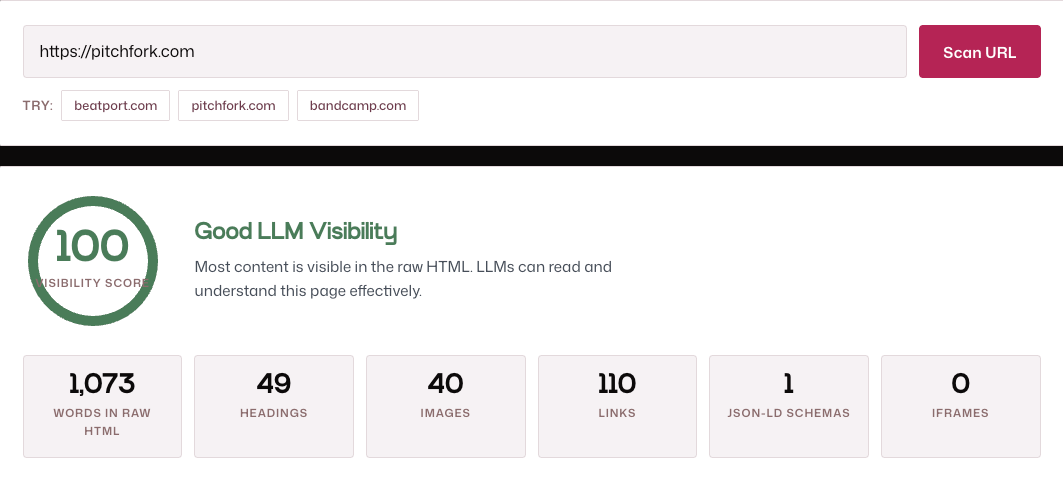
D. Don’t hide important text
We’ve known for a long time that text hidden behind tabs, carousels, modals, or other interactive elements tends not to rank as well as clearly visible text.
AI engines appear to work the same way.
If you have text hidden by tabs (CSS or JS), be sure to bring it into the open so humans, search engines, and LLMs can see it.
Step 2. Rank for the main query
To win AI citations, you want to aim for queries for which you already rank organically.
AI citations source their candidate URLs from top-ranking search results, so you want to be included in those results. You might even call it a requirement.
Do you need to rank #1? Not necessarily.
Although ranking higher helps, you probably need to be in the top 30 at a minimum to have a decent shot at consideration.
And even if you don’t rank at all, you can still appear as an AI citation if you rank for related searches, aka “fan-out” queries. (We’ll cover these next.)
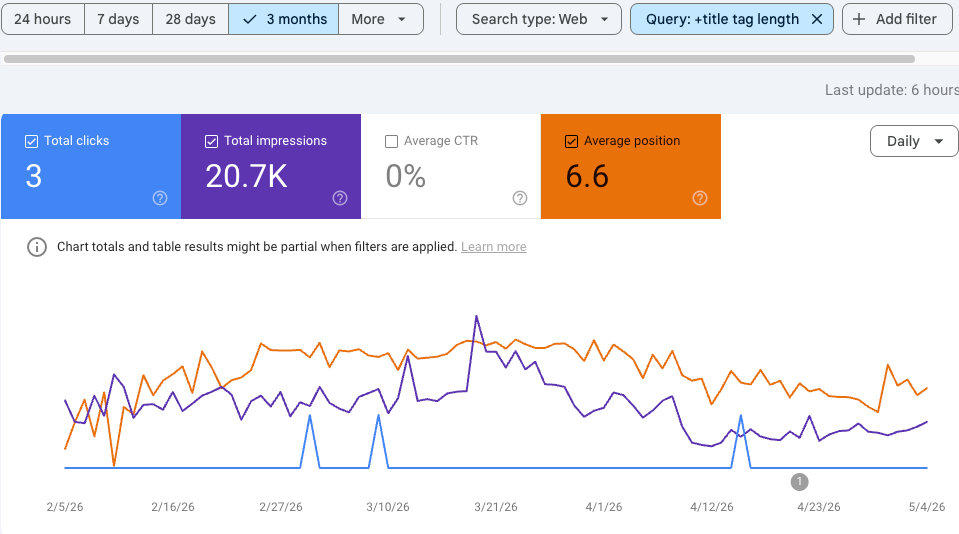
Regardless, select the query that triggers a Google AI Overview or AI answer with citations. It could be something like:
“Title Tag Length”
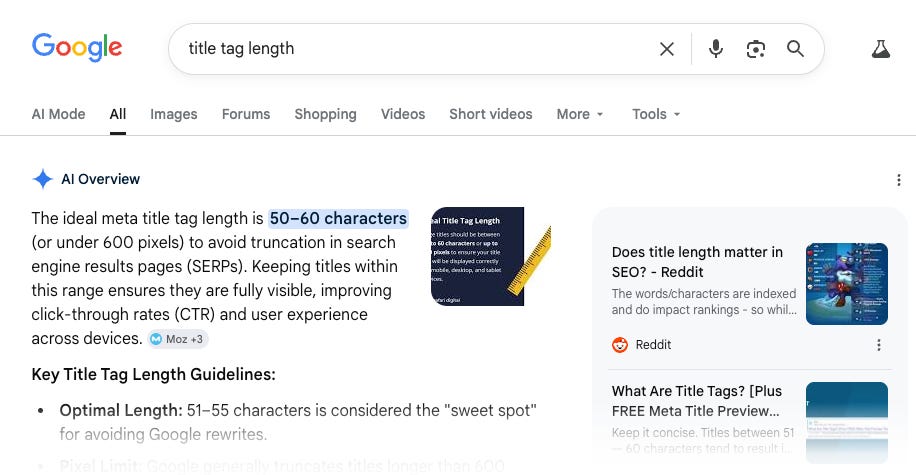
My website currently ranks around position 6 for this in Google search, with 20K impressions, so it should be a good query to target.
Step 3. Find and target fan-out queries
Here’s where optimizing for AI citations gets fun, in part because it can also raise your traditional SEO rankings and visibility.
When AI engines form an answer, they often perform fan-out or grounding queries to obtain additional information or to verify what they already know.
Ranking highly for these additional queries increases your chances of getting chosen for AI citations.
How do you find fan-out queries?
There’s no single “definitive” way to discover fan-out queries, as they change constantly among AI systems based on probability, personalization, and context.
That said, you can get pretty close by using a combination of three methods:
A. Observed Fan-Outs
For ChatGPT, several tools capture the exact fan-out queries used, including Mark Williams-Cook’s ChatGPT Fan Out Query Explorer. Note that these queries vary frequently, so use them only as a rough guide.
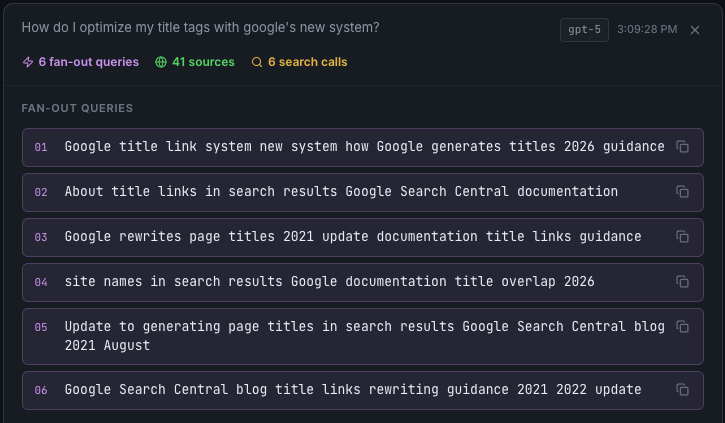
Other useful tools include:
Qforia by iPullRank
AI Visibility Fan Out by WordLift
B. Synthetic Fan-Outs
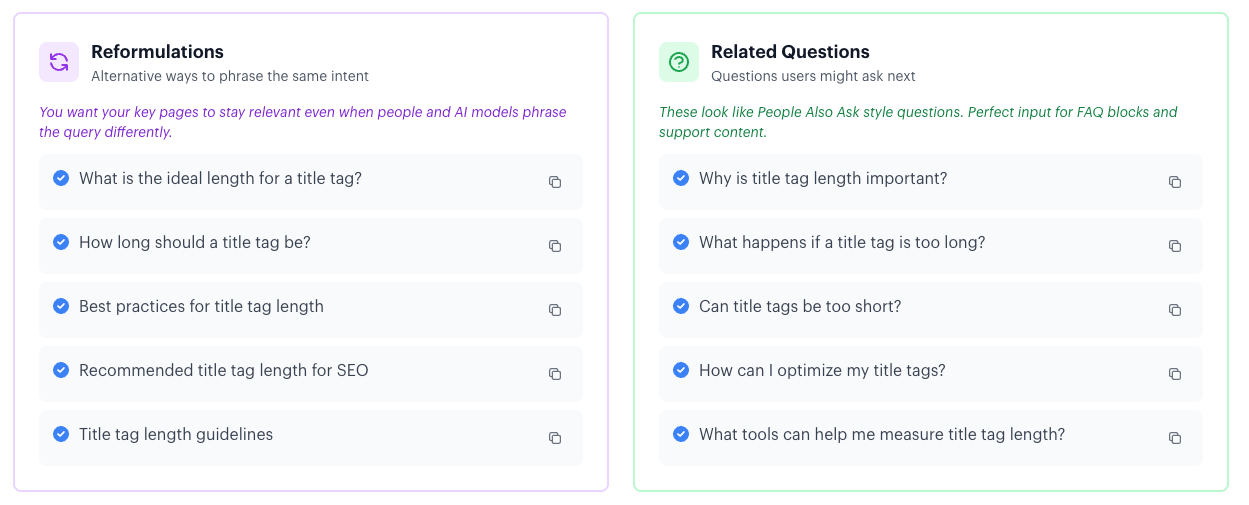
Many tools will “simulate” fan-out queries for you, like this one from Rankability.
C. Reverse-Engineer AI Answers
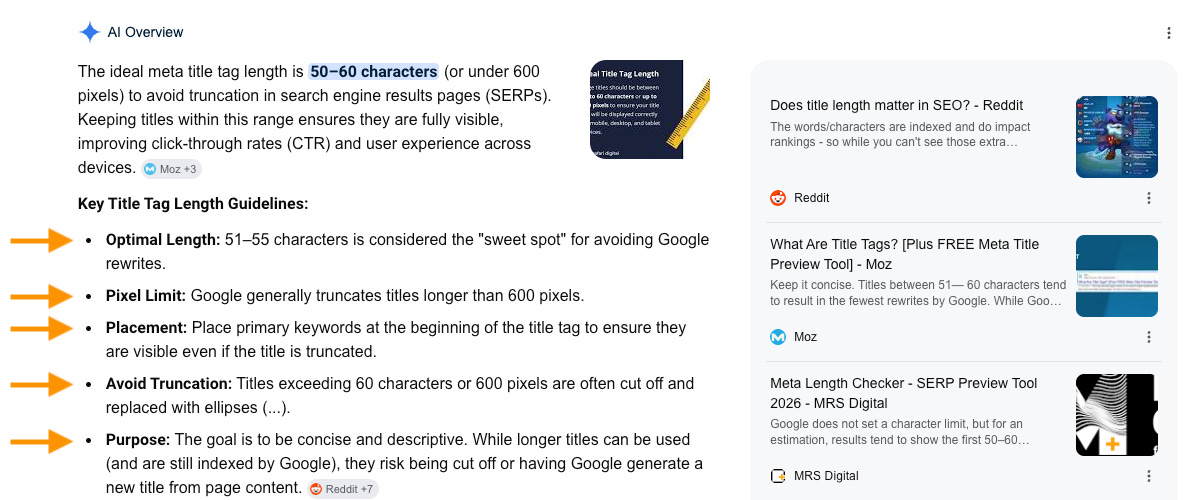
Oftentimes, simply noting what the AI engine returns for an answer will tell you exactly the type of content you want to rank for.
For our “title tag length” example, I probably want to make sure my content covers Optimal Length, Pixels, Placement, Truncation, and Purpose.
Should you try to rank for related queries with new pages or existing pages?
The answer to this question depends entirely on search volume and whether you think a separate page would be useful to users.
The goal is not to create a ton of pages simply for AI engines to digest. That’s probably a recipe for disaster.
If you think a topic/page can stand on its own, create it. Otherwise, it’s often fine—and sometimes easier—to update existing pages with updated section headings and content that directly addresses additional fan-out queries.
Important: You don’t need to try to rank for every fan-out query. In fact, it would be foolish to do so.
Instead, try to rank for the gaps in your existing content, for queries people are actually searching for. Not only will this likely help with AI citations, but it will broaden your ranking base across more real-world search terms.
To find gaps in your content, try IntentGaps.com.
4. Choose the right content format
If a user searches for “best places in Germany to visit,” the best content type for the answer will be very different for a query like “Apple watch specs vs Garmin Venu”.
The first is probably best served by a ranked list, the other by a comparison page.
It could be a side effect of AI engines citing highly-ranked pages, but many studies have found a correlation between page format and AI citations.
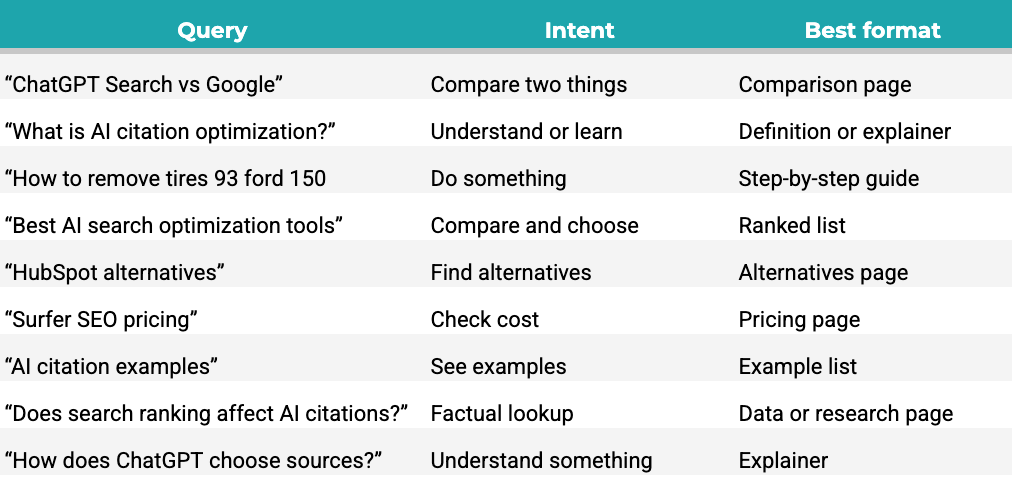
The easiest way to determine the right content format for your query is to simply observe what’s currently ranking for your query/fan-out queries.
5. Match the Answer to the Query
This is one of the stronger findings in the research. In an AirOps/Kevin Indig study, pages whose headings closely matched the original query were cited more often than pages with less strong matches.
Similar findings are supported by several other studies, patents, and research papers that show a strong semantic match between your page content and the AI’s query/fan-out query.
In practice, this means writing clear titles, headings, and answers that closely match the original queries.
To target multiple queries and fan-out queries, use subheads with accompanying text blocks where appropriate.
Query: ideal title tag length
Fan-out query: Google rewrite page titles
Bad example - Low Semantic Similarity with Query
Titles for SEO Relevance - How to Get Noticed
Your boss called. He wants you to update all the title tags on the company blog. He says Google isn’t displaying them the way he wrote them, and he wants you to fix it. One problem may be that your titles are too long. Google likes these to be under a certain character count. 60 is a good maximum.
Good example - High Semantic Similarity with Query
Ideal Title Tag Length - Avoid Google Rewriting
The ideal title tag length is 55-60 characters, based on our research of 3 million titles. To prevent Google from rewriting your page titles, it’s best to keep titles under Google’s 600-pixel desktop maximum.
To target multiple queries and fan-out queries, use subheads with accompanying text blocks where appropriate.
6. Put your primary answers at the top
Don’t hide the main answer of the page after a long, fluffy intro.
Several studies have found that standalone sentences early in your content are more likely to be picked up by AI.
This matters. According to Dan Petrovic, only about 32% of a page’s content gets picked up for consideration in the grounding process by Google Gemini.
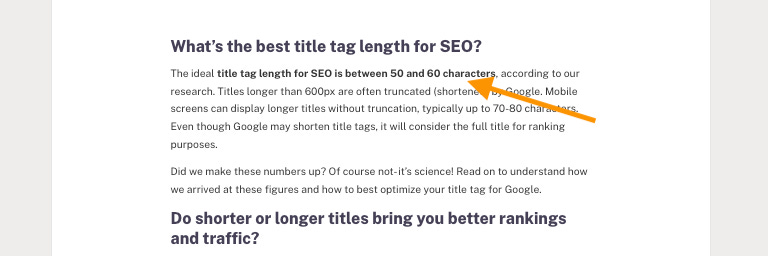
In practice, this may look like a short summary near the top of your content. Here’s how I wrote about “what’s the ideal title tag length?”
For a page about title tag length, you might write:
The ideal title tag length for SEO is between 50 and 60 characters, according to our research. Titles longer than 600px are often truncated (shortened) by Google.
This is unambiguous and direct, and its positioning means it’s more likely to be picked up by AI.
7. Make the page easy to cite
This one is a bit controversial, because many in the SEO world believe that you shouldn’t have to “write for LLMs.”
It’s not so much about writing for LLMs, it’s more about being clear and focused.
Dan Petrovic again, from his research:
“A tight 800-word page can get 50%+ of its content grounded. A 4,000-word page gets ~13%. Focus on making every sentence count rather than adding volume.”
In our Ranking Factors study, we found that three sentence structures were more likely to support AI citations.
A. Factually Specific: pages and passages that showcase specific, verifiable facts.
B. Explicit Phrasing: use specific claims over vague statements.
C. Site Sources: back up facts with referenced sources
D. Self-Contained Passages: important statements can stand alone without looking elsewhere in the text
E. Entity Consistency: use of consistent names for products, brands, people, etc.
Here’s an example of all these in action.
Poor: “The best title tag length depends on several factors. Some of these we discuss below. Shorter ones are sometimes better, but not always.”
Better: “Title tags between 50-60 characters are 40% less likely to be truncated by Google, according to our study of 41 thousand titles. Title tags longer than 600 pixels are likely to be truncated by Google.”
The latter is more factually specific, explicit in its phrasing, and cites the source of the information. It also uses consistent entity naming, and all the ideas are self-contained within the passage.
You don’t need to cite sources for every sentence, but you should cite sources for facts that need evidence, even if the source of evidence is yourself.
Does Winning AI Citations Matter?
Yes, at least in Google AI Overviews.
A study by Seer found that “Being cited in the AIO delivers +120% more organic clicks per impression versus when you are not cited.”
To win more AI citations, make your content accessible to AI crawlers, find the right search queries to target, discover and optimize for fan-out queries, use the right content format, put your most important content at the top, and use a clear sentence structure.
Happy citation winning!