


Home | AI SEO Marketing | Pro Templates
👋 Subscribe free (it helps me produce research like this) for proven tips + tactics on how to win more visibility in Google and AI search. Get SEO/AI strategies, new data, and frameworks delivered each week. Premium subscribers get full access.
If you sell anything online, chances are AI is changing how your customers find you, how you market to them, and ultimately how they make purchases.
Google, OpenAI, Amazon, and other platforms are releasing a flurry of new protocols to enhance AI product search, visibility, and may ultimately allow AI agents to buy your products directly.
Things are moving very, very quickly.
To get a grasp of these changes, I spoke with one of the world’s leading experts on “Agentic Commerce”. Tim Resnik led Product and SEO teams at Walmart and Wayfair, and in his role at Botify, advised some of the top e-commerce retailers in the world.
Tim has tips for everyone on AI shopping. Watch the interview here.
Here are the top takeaways from Tim’s interview.
1. Product Feeds and Catalog Enrichments Are Job #1
Traditionally, product feeds were left to the teams doing paid ads or pushed off to an agency. Tim argues that because feeds and new protocols are becoming a primary way for AI to understand your content, then optimizing those feeds and improving your catalog data becomes much, much more important.
“With [AI shopping results], what is happening is that Google needs that information really, really quickly … So the feeds are important to be able to express real-time availability and pricing. They need to know what products are out there in the universe to be able to suggest to their shoppers on these platforms in real time.”
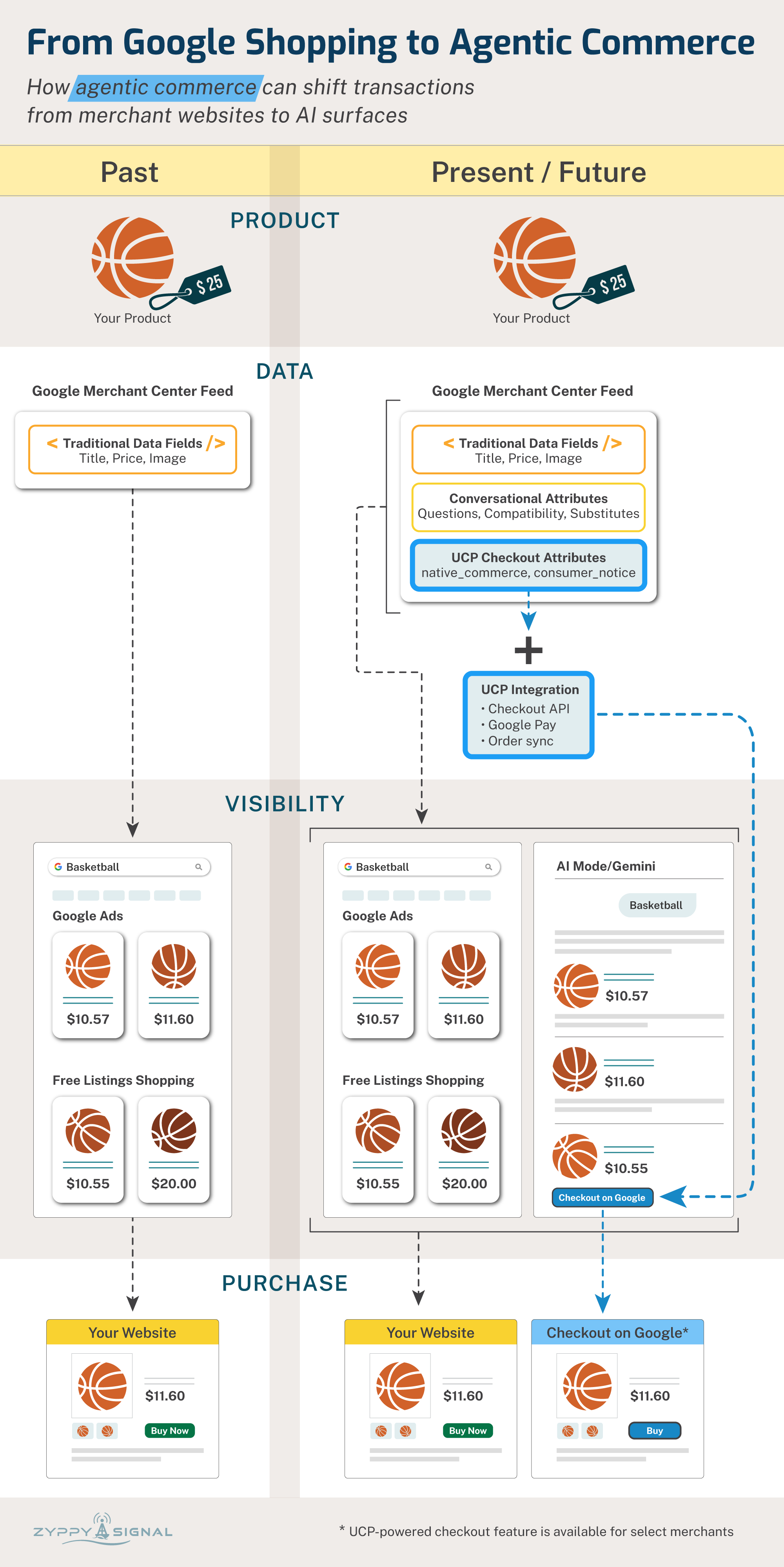
Google is developing new protocols, such as Universal Commerce Protocol, along with feed attributes, such as Conversation Commerce (currently in limited beta) to expand AI capabilities, but these still rely on your core product feed as your base.
Here’s an illustration of how some of these updated capabilities work in Google Merchant Center (and will in the near future) to enable AI integration.
Action: Treat your product feeds like valuable, canonical assets. As AI companies develop new protocols, feeds become a source of truth that they can access easily and reliably. AI needs real-time information, and your feed can provide that faster than waiting for a bot to crawl your site.
Additionally, cleaning up your feed and making it as error-free as possible becomes a bigger priority. Most feeds in Google Merchant Center are riddled with errors, and this can lead to inefficiencies in surfacing your product.
2. SEO Basics Are Even More Important in an AI World
AI bots don’t all read your content the same as Google does, and can struggle with things like JavaScript-heavy sites. Slow load times, poor site architecture, and other basic SEO issues can prevent AI bots from even seeing your products in the first place.
“And I will say … this SEO is pretty important. Like your fundamentals, they’re called fundamentals for a reason, you know?... If there’s lots of JavaScript, we know really all the non-Google bots, especially like anything coming from OpenAI, not that they’re crawling the full web at this point, but they have a hard time processing JavaScript.
It costs Google a lot of money, and we know Google’s putting a lot of money into other things, probably like data centers and TPUs and chips and all that stuff. So they’d probably prefer to have really fast HTML”
Action: Focus on SEO basics before any new AI tactics. “Basics” may be the wrong term to use here, but making sure you have fast load times, good internal linking, and your site doesn’t rely too heavily on hard-to-parse JavaScript will go a long way in helping AI bots understand your product catalog. Pay those SEO folks!
3. Brand & Loyalty Play Outsize Roles
In an AI Shopping world, AI platforms have access to millions of data points, including information on your products and your competitors. This makes competing on things like price even harder. And if customers purchase on AI platforms instead of on your sites, your advantages erode even further.
Tim makes the point that Brand and Loyalty become increasingly important in these perfect information systems. To stand out, companies need good PR and a brand that stands out.
“The other piece is brand, right, and loyalty, because at the end of the day, if. There’s going to be a real person, I hope, behind the agent that is buying something, and that person is gonna have an affinity and they’re gonna have loyalty to a brand. Sometimes it’ll be irrational loyalty, but it’s still like a loyalty that you can build upon, right?”
Action: Focus a little more on your Brand, and less on your keywords. We know that brand is important in SEO, but many companies sadly neglect it. Instead of pouring all your budget into ranking for “best mattress online”, try to get a little more attention for your company, “Mattress Kindom.” Invest in digital PR that showcases both your brand and your product.
4. True “Agentic Commerce” Isn’t Here Yet
Tim argues that while companies are rolling out new protocols, it’s far too early to call this the age of Agentic Commerce. While AI is changing how people discover and shop for products, almost all purchases are still via traditional routes.
We may soon have a future where our agents buy our batteries from Amazon without us thinking about it. That future is still far enough off that we’re not sure what it looks like yet.
“Instead of a human shopping and buying things, you have a robot or an agent that’s going out, and it’s doing the discovery for you. It’s doing the consideration, maybe involving you in the loop to some degree. Then it’s actually making the transaction and dealing with the order until the thing just comes to your door. So you open your fridge, and there’s no orange juice left. All of a sudden there’s some orange juice in your fridge type of thing...
I think that’s the pure definition, [giving full] delegated autonomy to an agent, but I don’t think we’re even close to that yet.”
According to Tim, the biggest winners in AI shopping are most likely going to be the companies that:
Possess operational excellence
Nails the SEO basics better and tighter than everyone else
Have a strong brand presence
The smart companies aren’t chasing shiny objects yet. But everyone is getting ready to play with new tools.
Important Links
Want to discuss AI Shopping or have questions? Join the subscriber chat.