



👋 Subscribe free (it helps us produce research like this) and get tips + tactics on how to win more SEO and AI visibility.
We asked 131 SEOs, including some of the most respected in the industry, what factors are most important for ranking on Google in 2026.
And they delivered.
Lots has changed in SEO since Rand Fishkin published the very first Ranking Factor survey in 2005. Since then, we've had the emergence of AI, revelations from API leaks and antitrust trials, and multiple Google algorithm changes. To keep up, we designed this survey to reflect these newer factors, and we're honored to carry on the tradition.
In total, our experts generously contributed 13,665 ranking-factor data points for analysis. To our knowledge, this is one of the largest and most up-to-date collections of external expert knowledge on how Google actually works.
How We Measured Ranking Factors
Each expert scored and evaluated more than 100 potential Google ranking factors. Respondents were asked, “How much of a positive or negative effect do you believe each of the following factors has on Google’s organic search rankings?“
Respondents then rated each factor on a 7-point scale, from +3 (Strongly Positive) to -3 (Strongly Negative).
Finally, the respondents were asked an open-ended question: “What are the three most important Google ranking factors?“ For this question, they could answer anything they wanted.
Google’s Most Important Ranking Factors
After crunching the numbers, while the most critical ranking factors haven’t changed tremendously from past years, the details matter - especially in terms of AI, user click signals, and deeper content characteristics.
According to our experts, the most important Google ranking signals in 2026 are Relevance, Backlinks, and Content Quality. We’ve listed the top 10 below, along with the percentage (%) of respondents who selected it as a “top 3” factor.
1. Relevance - 57.1%: Content is relevant if it matches and satisfies the search intent of the user. The content should semantically match what the user is looking for and satisfy their needs.
2. Backlinks - 54.8%: The rumor of the death of backlinks has been greatly exaggerated. In fact, respondents rated links from trusted, relevant sites as one of the most important factors. Many experts emphasize the importance of links from pages with real visitors.
3. Content Quality - 47.6%: Nearly half of our experts listed elements of content quality as a top-ranking factor. This includes features such as originality, accuracy, and freshness.
4. Authority & Trust - 36.5%: How much Google trusts the website, creator, or brand/business.
5. Behavior / Click Signals - 29.4%: How users select search results and interact with web pages. Google watches the user.
6. Brand Signals - 27.0%: The importance of being a brand/entity that people search for, trust, and visit.
7. User Satisfaction - 19.8%: User satisfaction or “task completion” as the ultimate outcome.
8. Technical SEO Health - 17.5%: Crawling and indexing form the foundation for all other ranking factors.
9. Topical Authority - 14.3%: How well your brand/site is associated with expertise on a particular topic.
10. Internal Links - 11.1%: How you connect web pages on your site through links and site architecture.
Let’s dig deeper into the individual factors to see what matters. You can find definitions for many of the ranking factors here.
1. Content Relevance
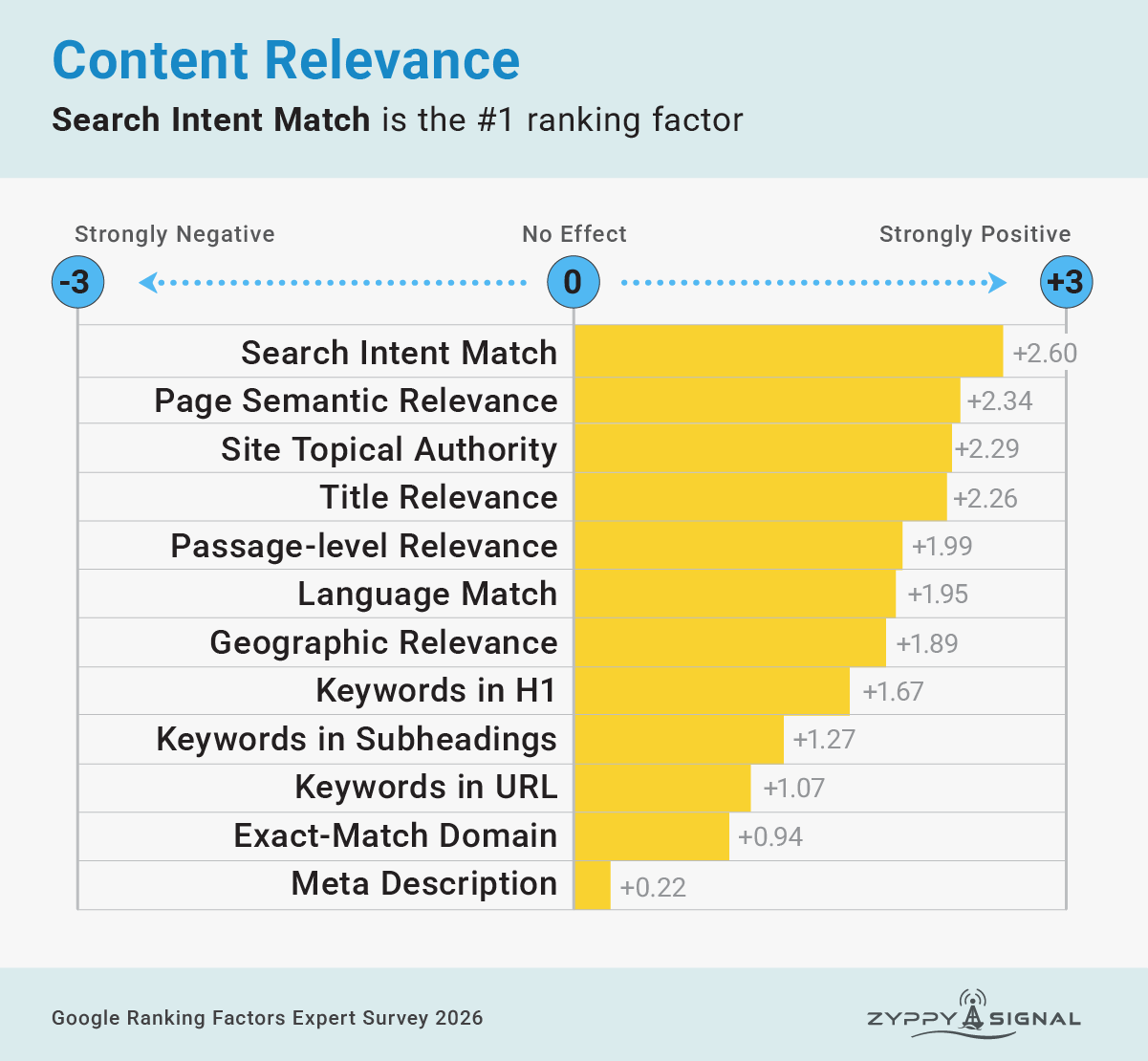
Out of all the over 100 ranking factors we quizzed our experts on, “Search Intent Match“ was the clear winner.
Search Intent Match is defined as “How well the page satisfies the type of result or task the searcher appears to want.” Notably, this goes beyond simply matching keywords and semantic relevance, because our experts say you actually need to give users what they want.
Surprisingly (or not), the lowly Meta Description was rated so ineffective that most SEOs don’t believe it has any impact.
Expert Comments on Relevance

“You can have technically perfect content with pristine headings and a gorgeous URL structure, but if the person searching wanted one thing and you answered another, none of that saves you.”

“I’d add information gain. Once ten pages all match the intent and cover the same ground, what decides it is whether a page adds something the others don’t.”

“I’m just as surprised as everyone else by how effective EMDs are still. We are ranking an EMD for a competitive term with a fraction of the effort for our main site that is competing for the same term.”
2. Backlinks
Who says you don’t need backlinks anymore?
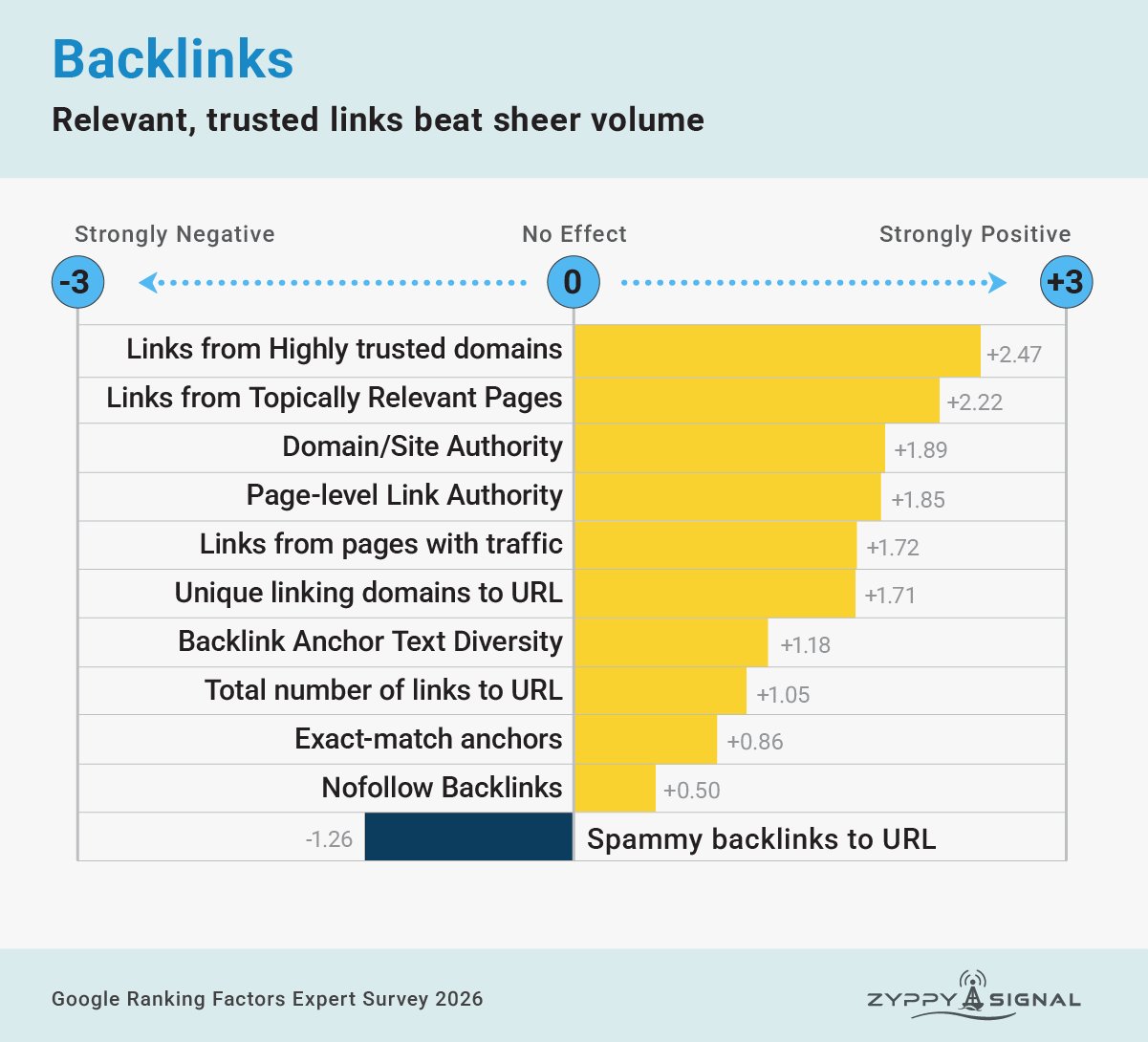
“Links from highly trusted domains” and from “topically relevant pages” were two of the highest-rated factors across the entire survey.
Meanwhile, even though Google says they ignore most spam links, these were rated as one of the biggest negative ranking factors.
Expert Comments on Backlinks

“A hundred links from real audiences beat a thousand links nobody ever clicks.”

“With AI, links can have an even greater effect. A client recently got mentioned and linked from a Reuters article a few weeks ago. Their visibility in ChatGPT went up 4x over the next week.”

“Exact match anchors cut both ways. They drive real gains up to a point and suppress performance past it. The variable is what share of the anchor profile they represent, not the raw count.”
3. Content Quality
Content Quality is where our ranking factors begin to diverge significantly from past surveys.
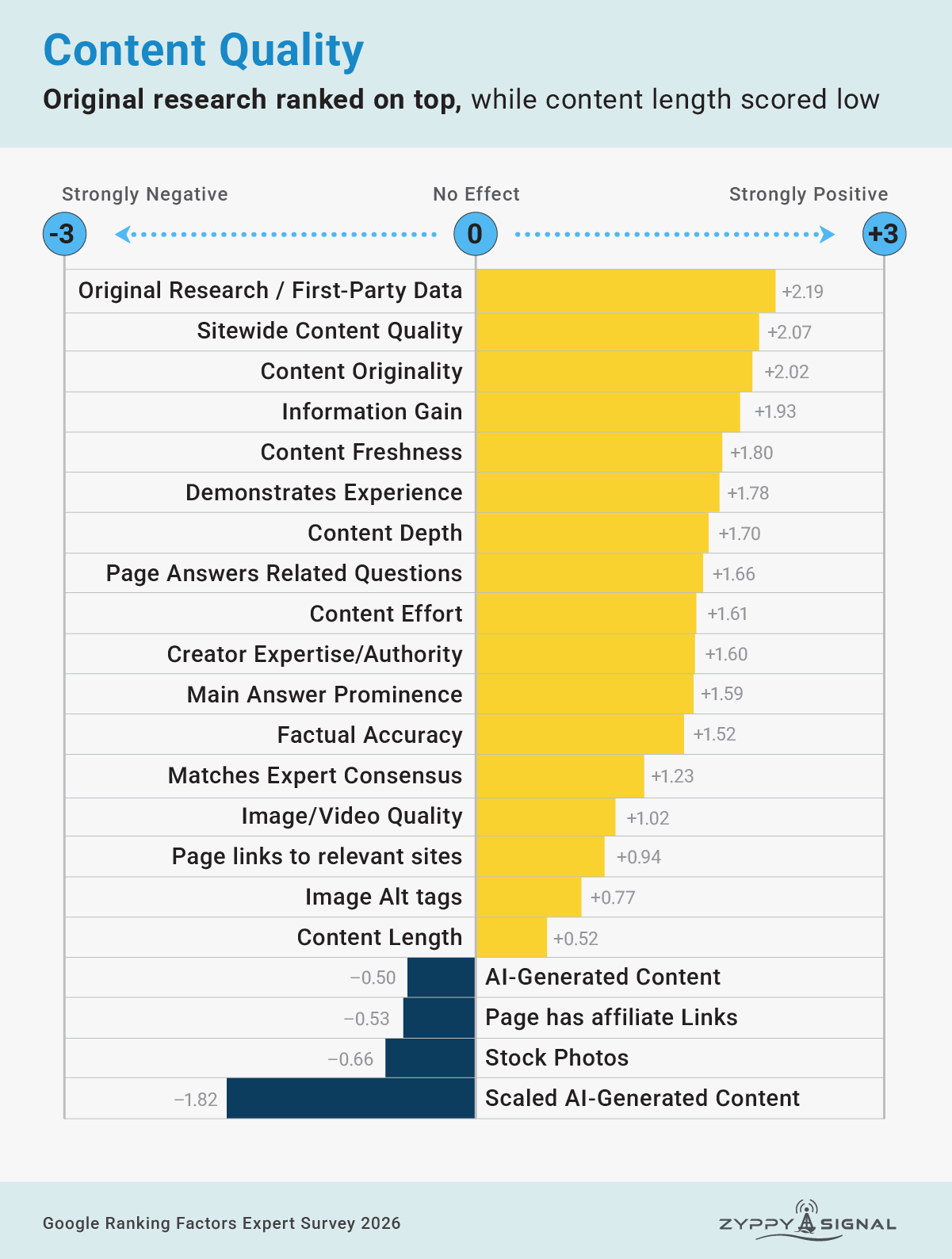
“Original Research” and “First-Party Data” top the list, reflecting the importance of producing unique, non-commodity content in the age of AI.
Many saw AI-generated content negatively, but only when it is scaled with little added value.
“Using AI to help you publish ten times the amount of the same quality content in half the time is not as good as using AI to help you publish the same amount of content, but ten times the quality.”
Expert Comments on Content Quality

“Too much consensus, and you’re invisible for not being relevant enough. Too much information gain, and you’re shadowbanned for being too contrarian.”

“AI has made content cheap. Anyone can spin up a thousand articles overnight. And Google knows it. That’s why quality is becoming the filter. When the volume of content explodes, the cost of publishing drops to zero... but the cost of trust goes up.”

“I have seen positive results from high-quality AI generation at scale. This is on a site that has plenty of unique content and UGC, and AI content undergoes intensive human editor review.”
4. Brand & Reputation
Brand is one of the primary ways Google learns who to trust.
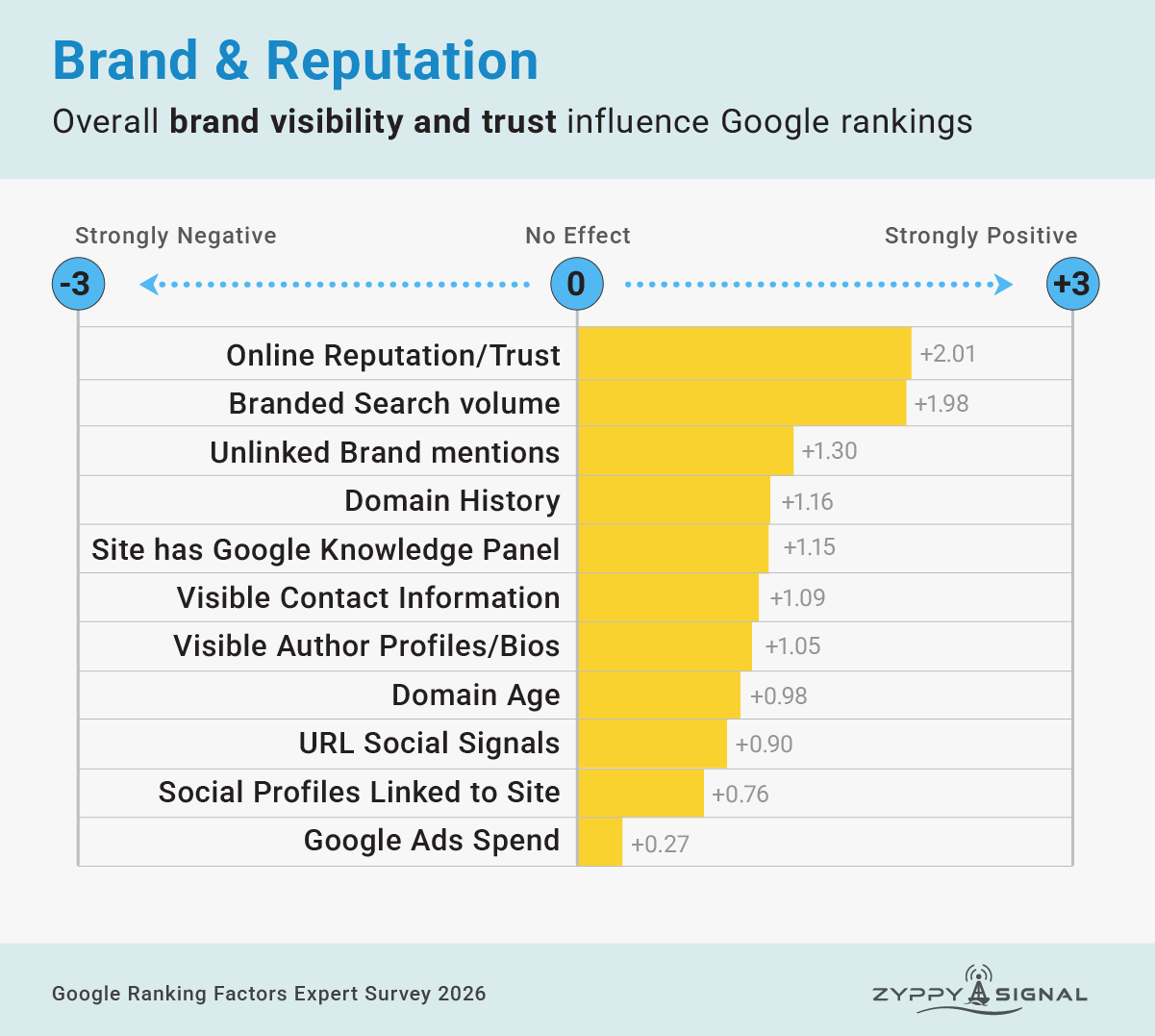
“Online Reputation/Trust” and “Branded Search Volume” (e.g., how many people search for you by name) were ranked as two of the most important factors.
An oldie-but-goodie, “Google Ad Spend,” snuck by with a barely positive influence, presumably because it can boost your visibility.
Expert Comments on Brand & Reputation

“It's a popularity contest. Once Google finds you relevant for a query, it doesn't really reward 10x content... In fact, I'll go as far as to say that content that is too expert-level is actually harmful to visibility. You need to hit the Goldilocks zone where you appeal broadly to as many people as possible and get talked about, shared, linked, and mentioned.”

“Brand signals are the strongest factor in my opinion. You can get away with a website technically in a very bad shape, without having optimized content as long as people search and talk about the brand.”

“Branded Search is the new link, since 2012, if a Google patent is to be believed.”

“No direct effect of ad spend - it can affect other signals, though, so it can result in benefit.”
5. User Signals
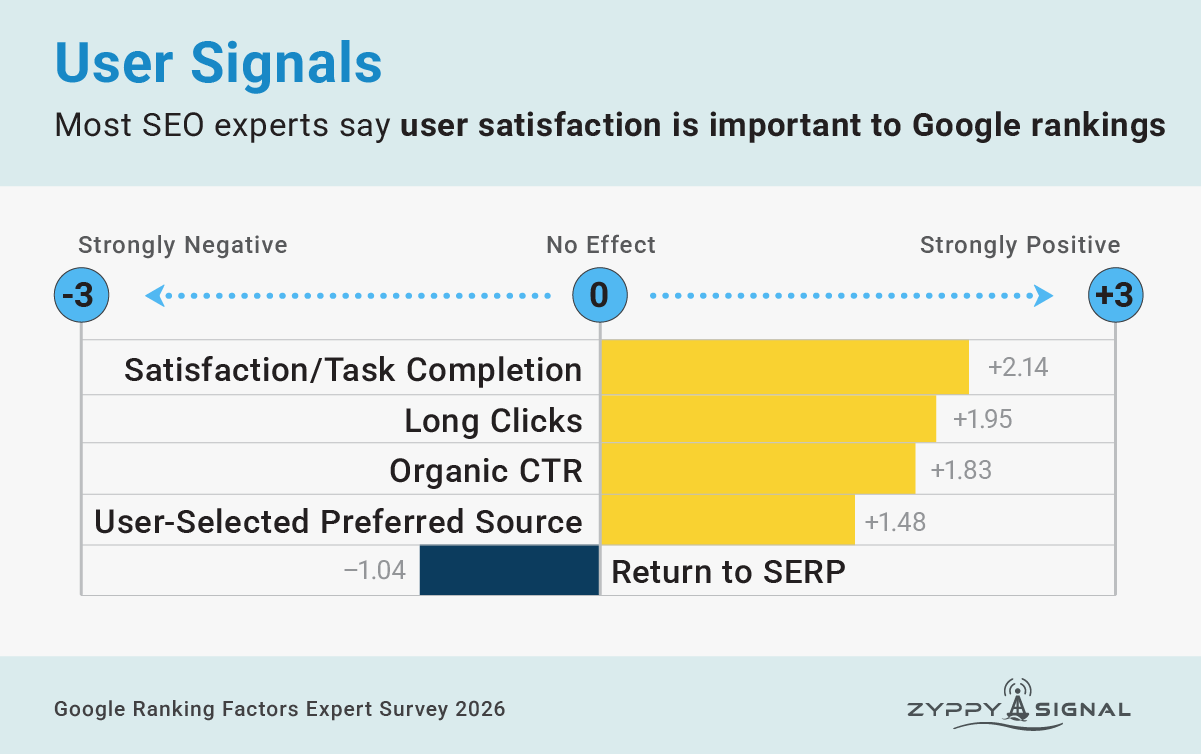
With evidence revealed from Google’s antitrust trial and API leak, user-based signals took a big leap in this year’s survey.
SEOs now better understand how closely Google watches what users do.
“Satisfaction/Task Completion” was rated highest among the user signals, while “Return to SERP” (the searcher returns to Google's results after visiting the page) was rated negatively.
Expert Comments on User Signals

“Navboost is still a monster. As such, sites really should create a satisfaction metric (often by page type) to try to emulate satisfaction. Because there is a ranking ceiling when click signals are worse than other SERP competitors.”

“Bounce rate is a bad metric, but sites where users pogo-stick to another result, I believe that is a clear signal that Google is absolutely taking.”

“User signals are the final verdict of search engines. My question is: when most browsing becomes agentic, how will they measure them?”
6. Technical SEO
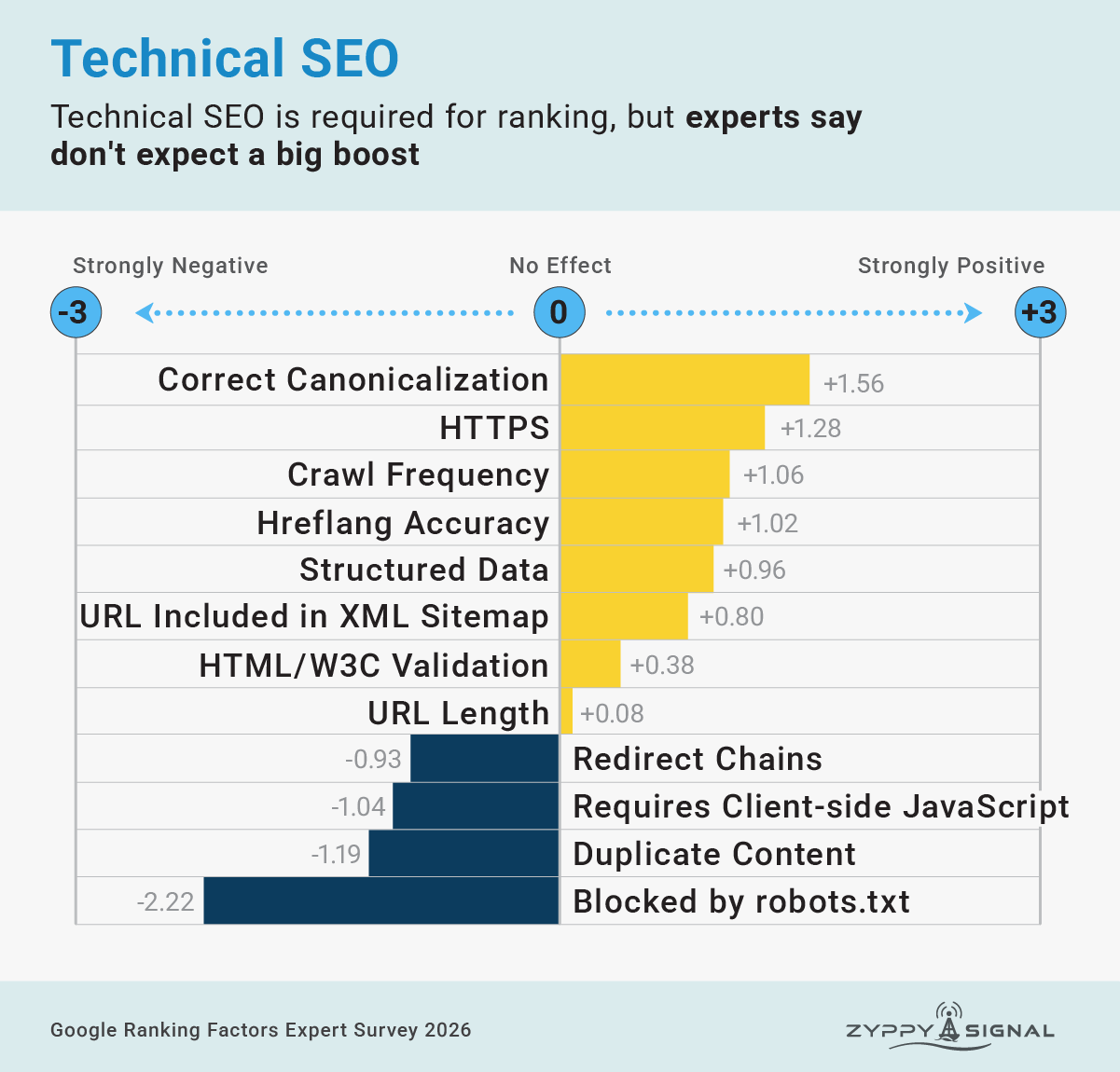
Google's ability to crawl and index your pages forms the basis of SEO. As such, solid technical foundations make all other ranking factors possible.
Most respondents described technical SEO as “table stakes.” While bad technical SEO can definitely hurt, you shouldn’t expect good technical SEO to elevate otherwise mediocre content.
Expert Comments on Technical SEO

“Tech SEO is a commodity at this point. It won’t necessarily win the race, but it can absolutely lose it.”

“We were working with a client who accidentally set their canonicals pointing at pages that weren’t at all similar to the original content. Once that was fixed they saw an almost immediate positive change in their impressions and clicks -- I think it was around +60%.”

“I increasingly evaluate technical SEO as infrastructure for machine understanding as well as retrieval.”
7. Internal Links & Site Architecture
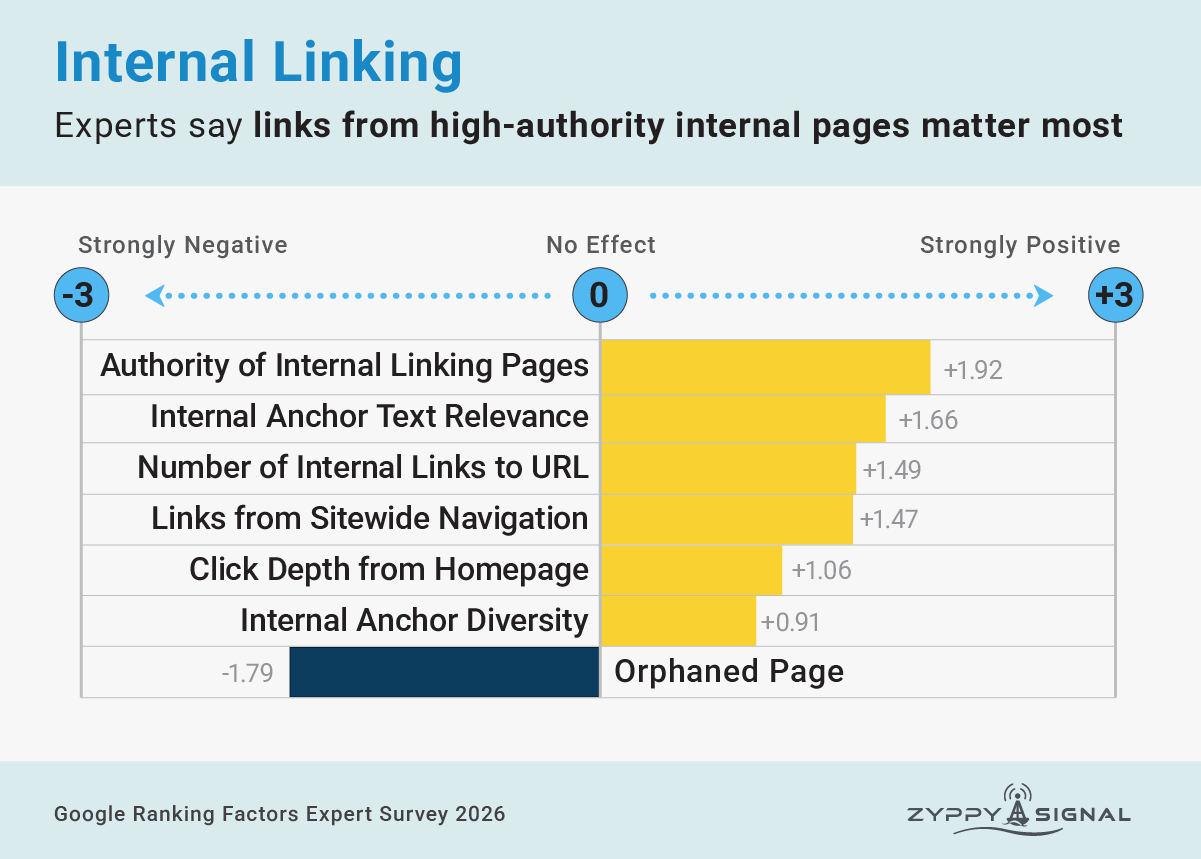
Internal links are often considered the little brothers and sisters of the big, powerful external links.
But many of our experts suggested that internal links, when executed properly, can play a powerful role in your SEO strategy.
Expert Comments on Internal Links

“I often discuss with colleagues that a good internal link is as valuable as a very good external backlink.”

“Internal linking is the ranking lever a site controls end to end... Internal links decide which pages collect equity, which pages Google reads as important, and how topics connect across the site.”
8. UX
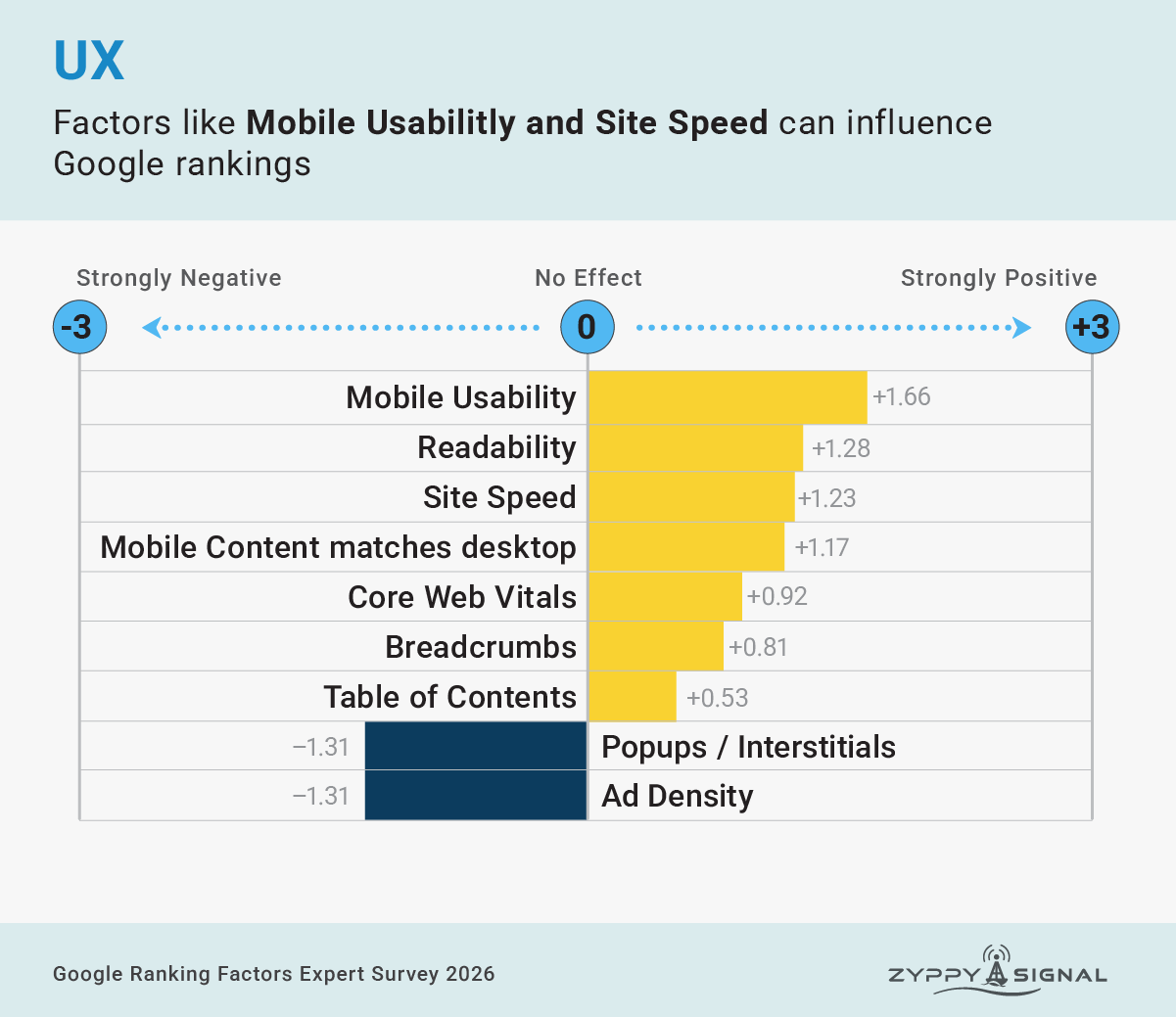
Our respondents said User Experience signals mattered, especially Mobile Usability.
At the same time, Site Speed and Core Web Vitals were two of the most controversial ranking factors, with many competing views.
Expert Comments on UX

“UX factors matter more because they influence behavior. Yes, Google checks ‘em, and they directly impact rankings, but behavior matters more as it affects Navboost and other bits and pieces of the algorithm.”

“Speed and CWV are the most over-rated things in SEO. Those are literally one of the smallest factors ever - if they’re still even used. It’s either it loads and you’re fine, or it doesn’t load in time and you’re not fine.”

“For a huge ecom site, speed REALLY matters. For a local car dealership, it’s pretty common to have a site that takes several seconds to load on certain pages, but it’s kind of expected - people want those huge detailed images.”
Next: Google AI Ranking Factors
Wait, there’s even more ranking factors?
Yes! We also surveyed our experts on ranking in Google’s generative AI responses. Our next post covers how to get noticed, recommended, and cited by Google’s AI Answers and AI Mode. Subscribe for updates.
👋 Subscribe to stay updated and get the Google AI Ranking Signals Expert Survey directly in your inbox. It also helps support our research.
Kudos to our Contributors!
Putting a survey like this together is a lot of hard work.
We considered literally 100s of potential Google ranking factors and whittled them down to 103 of the most salient. We reached out to over 200 respected SEOs (most SEOs hate the word “expert”) and played cat and mouse with bad email addresses and missed DMs.
But the real work came from these contributors. Collectively, they generously spent 2,620 minutes (43.6 hours) completing the survey and contributing their expertise to advance our shared knowledge of SEO. Hats off to you!
Even though I am immensely proud of this group, no collection of SEO experts is ever complete, and we undoubtedly missed many folks (or my emails went to spam). If you’d like to be considered for future editions, you can register your interest here.
Contributors - Google Ranking Factors Expert Survey 2026
All Contributor Credits
Shahzad Abbas — Define Media Group · Tony Adam — Visible Factors · Barry Adams — SEO for Google News · Shai Aharony — Reboot Online · Jono Alderson — Jono Alderson · Glen Allsopp — Ahrefs
Jason Barnard — Jason Barnard · Jan-Willem Bobbink — GSC Wizard · Matthew Brown — Infinite Visibility Group · Carl — Audits.com · Claire Carlile — Whitespark · Crystal Carter — Wix
Andy Chadwick — Andy Chadwick · Zach Chahalis — iPullRank · Przemysław Charchan — LinkedIn · Debbie Chew — Debbie Chew · Jean-Christophe Chouinard — JC Chouinard · Brodie Clark — Brodie Clark Consulting
Andrew Cock-Starkey — Optimisey · Michael Cottam — Michael Cottam · Simon Cox — Simon Cox · Will Critchlow — SearchPilot · Blake Denman — RicketyRoo · Dana DiTomaso — Kick Point
Jason Dodge — BlackTruck Media + Marketing · Jason Dowdell — ZenBusiness · Jarno van Driel — Invisible Graph · Miriam Ellis — Miriam Ellis Consulting · Nick Eubanks — Digistore24 · Gianluca Fiorelli — I Love SEO
Micah Fisher-Kirshner — MicahFK · Duane Forrester — CitationIQ · Maryanna Franco — Maryanna Franco · Garrett French — Citation Labs · Greg Gifford — SearchLab Digital · Abby Gleason — Abby Gleason
Tory Gray — Gray Dot Co · Chris Green — Chris Green · Bastian Grimm — Bastian Grimm · Koray Tugberk Gubur — Holistic SEO · Joshua Hardwick — Joshy Digital · Bill Hartzer — Hartzer Consulting
Joy Hawkins — Sterling Sky · Dan Hinckley — Herringbone · Ian Howells — LuckyPixel · Shawn Huber — LinkedIn · Adam Humphreys — Making 8 · Kevin Indig — Growth Memo
Jamie Indigo — Not a Robot · Diego Ivo — Conversion · David Iwanow — David Iwanow · Ryan Jones — SERPrecon · Jess Joyce — Jess Joyce · Aimee Jurenka — Aimee Jurenka
Geoff Kenyon — Pomar · Amanda King — FLOQ · Michael King — iPullRank · Adrienne Kmetz — Adrienne Kmetz · Jordan Koene — Previsible · AJ Kohn — Infinite Visibility Group
Olaf Kopp — Kopp Online Marketing · Cindy Krum — MobileMoxie · Malte Landwehr — Malte Landwehr · Nick LeRoy — SEOjobs.com · Aires Loutsaris — Aires Loutsaris · Ian Lurie — Ian Lurie Consulting
Nitin Manchanda — LinkedIn · Matt McGee — SEO Savvy Agent · Matthew Mellinger — SEO Gets · Dr. Pete Meyers — Moz · David Mihm — Near Media · Sally Mills — Sally Mills Consulting
Roger Montti — Martinibuster.com · Niki Mosier — NASM · Natzir — Natzir · Vince Nero — BuzzStream · James Norquay — Prosperity Media · Corey Northcutt — Orbit Media Studios
JR Oakes — Locomotive · Victor Pan — HubSpot · Sam Partland — Sammy SEO · Gus Pelogia — Gus Pelogia · Dan Petrovic — DEJAN · Heather Physioc — Heather Physioc
Melissa Popp — RicketyRoo · Max Prin — LinkedIn · Nik Ranger — Nik Ranger · Lily Ray — Algorythmic · Tim Resnik — Tombras · Fabio Ricotta — Agência Mestre
Gaston Riera — Gaston Riera · Kyle Roof — PageOptimizer Pro · Peter Rota — Peter Rota SEO · Elizabeth Rule — Sterling Sky · JH Scherck — Growth Plays · Sheena Schleicher — Schleicher Marketing
Jes Scholz — Jes Scholz · Barry Schwartz — RustyBrick · Eli Schwartz — Product Led SEO · Will Scott — Search Influence · Paul Shapiro — Search Wilderness · Darren Shaw — Whitespark
Cyrus Shepard — Zyppy · Adam Sherk — Define Media Group · Andrew Shotland — Local SEO Guide · Dan Shure — Evolving SEO · Marshall Simmonds — Define Media Group · Ross Simmonds — Foundation
Oliver Sissons — Search Informer · Everett Sizemore — Everett Sizemore · Ann Smarty — Smarty.Marketing · Chris Silver Smith — Argent Media · Aleyda Solis — Orainti · Tim Soulo — Tim Soulo
Stephan Spencer — Netconcepts · Patrick Stox — Patrick Stox LLC · Edward Sturm — Sturm Media LLC · Garrett Sussman — iPullRank · Alexandra Tachalova — Digital Olympus · Venchito Tampon — Link Building Services IO
Marcus Tandler — Mediadonis · Marcus Tober — Marcus Tober · Steve Toth — Notebook Agency · Mark Traphagen — seoClarity · Pavel Ungr — SEOloger · Andrea Volpini — WordLift
Gerry White — Dergal · Fili Wiese — Search Brothers · Jessie Willms — WTF is SEO? · James Wirth — Citation Labs · Matthew Woodward — LinksThatRank