


Nearly every web marketer understands the importance of links for SEO.
Googlers, under oath, have described links as a top-3 ranking signal (along with content and user signals). Our own SEO Expert Survey rated links as the second most important Google ranking factor.
But the truth is, with trillions of low-quality links on the internet, Google ignores most of them.
In fact, Google likely ignores many of your links right now.
And if Google isn’t ignoring them, it’s likely discounting many because it doesn’t fully trust them.
You probably know all the standard SEO advice about links:
Use keywords
Vary your anchor text
Don’t overdo exact-match
Vary your anchors from page to page
Get links from topically relevant pages with actual traffic, etc.
But even if you follow all of the best practices perfectly, Google will still likely ignore—or at least discount—many of your links, and not for the reasons you think.
Google might ignore/discount links for many reasons. Overall, Google assigns more weight to links that:
Show relevance
Come from a trusted source
Convey new/unique information
Arise because of independent editorial decisions
Links can still “count” even if they don’t perfectly meet these criteria, but you might inadvertently reduce their full potential if you don’t know the hidden signals Google looks for.
If you can make more of your links count—and carry more weight—your SEO and AI efforts will get far more leverage from the links you build.
This guide shows you how to structure your links so that Google actually pays attention to them.
1. Top-Tier Links May Give You Magical Powers
Most marketers understand that not all links are equal.
We’ve known for years that links from high-authority, trusted sites can carry more weight than the run-of-the-mill links typically found on the internet.
But most SEOs probably don’t realize how strongly Google has hard-coded this preference into its ranking algorithm.
So SEOs focus on easy links. If they get enough, maybe all those links will add up.
But to Google, it’s as if really good links have magical powers.
Here’s an example: Google’s API documentation shows it can record a PageRank score for the page linking to you, from 0 to 65,535.
So far, so good. More powerful links have a higher PageRank, as expected.
But when evaluating link quality, Google says “anchor with pagrank > 51000 is the best anchor” and “anchors with pagerank < 47000 are all same.”
In other words, at least in this system, Google treats the highest-PageRank links differently from all the rest.

In theory, if all your backlinks come from the same lower-quality bucket, you’ll have a harder time ranking against competitors with links from the “Best anchors” bucket.
But the magic of powerful links goes way beyond that.
A single “trusted” link can possibly rescue 100s of suspicious links.
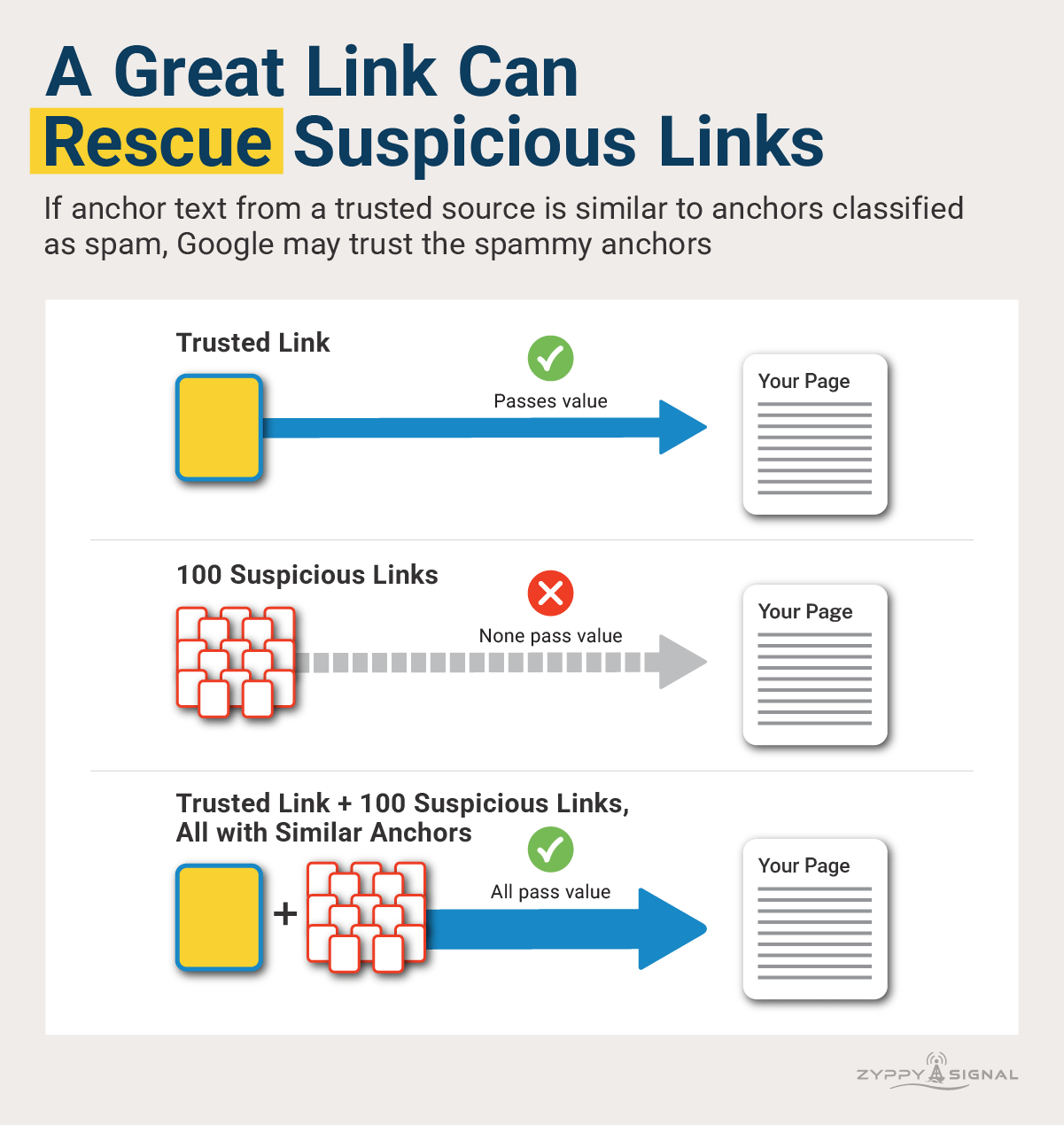
For example, let’s say Google finds 100 different links pointing to your website, all with the same suspicious anchor text.
Because they’re suspicious, Google labels them as spam.
But then Google spots a link from a trusted domain (perhaps a government or university site) with nearly the same anchor text. Google’s matchedScore attribute says, “that anchor text from this trusted source is similar to anchors classified as spam, which means that spammy anchors are legitimate.”
In other words, Google now trusts your 100 suspicious links because they’re similar to links from a trusted source.
Your one good link conceivably rescues the poor.
So many websites pursue easy link building, believing that the benefits of lots of links will compound, and wonder why they never break out of the bubble.

Smart money pursues the highest-quality links because these links have magical powers.
2. Utilize Anchor Context
Most people focus on anchor text when building links.
That’s fine. Anchor text matters, and we’ll cover it later.
But anchor text itself is only one part of what Google considers when evaluating links.
Google tells us that the words around the anchor text matter for context, but most people don’t realize how powerful these words can be.
A Google patent by Anna Patterson and Paul Haahr (two titans of Google search) explains how Google can utilize unique words before and after the anchor text to determine context. Google can then use this context as a distinct ranking factor.
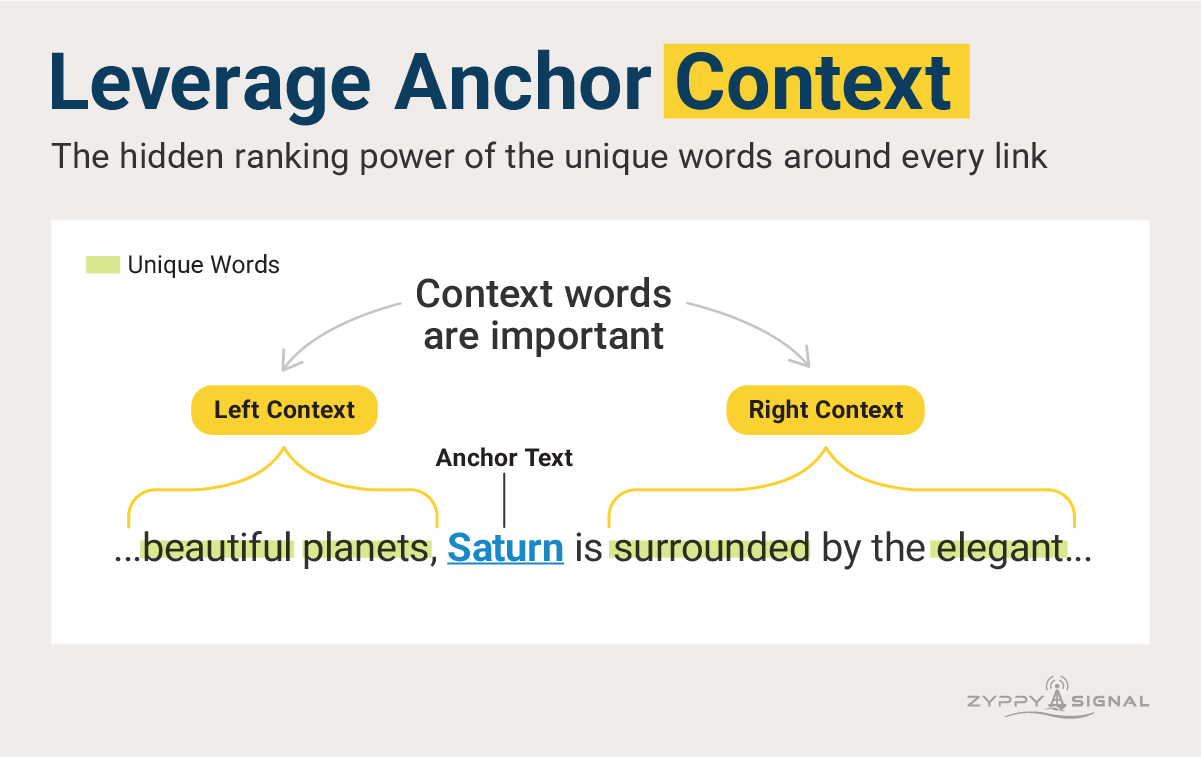
Google’s API leak even documents attributes that measure this exact thing: fullLeftContext, fullRightContext, and context2, defined as “a hash of terms near the anchor.”
Patterson and Haahr explain that Google can rank pages “based on the number of different contexts associated with the links.” Conversely, if many contexts look very similar, Google may discount those links as suspicious or spam.
This also means that links with little or no surrounding text may be less valuable to Google.
The takeaway is that you can use the words around your links as a potential ranking surface. The evidence suggests that the more differentiated and relevant you make these contexts, the better off you’ll be.
Don’t do this:
Here’s a good plumber.
Do this:
For outstanding residential plumbing services in New York, Joe’s Plumbing specializes in bathroom repairs, remodels, and 24-hour service.
This is also a good time to talk about link placement.
The best place to get a link is high up in the main text of an article. Not in the sidebar, footer, widgets, or any place considered “boilerplate.”
Partly because Google gives more weight to links people are more likely to click.
But Google’s famous Reasonable Surfer patent also considers the words before and after the link as a measure of importance. Links within highly relevant article text are more likely to possess richer context, and links higher up are more likely to be clicked.
3. Ditch the “Deliberately Different” Anchors for Editorial Diversity
Classic SEO often advises mixing up your links and anchor text. You may have even seen recommendations to vary your anchors like this:
10% exact match - “tax software”
20% partial match - “preferred tax platforms”
30% branded - “Taxsoft®”
20% naked URL - “taxsoft.com”
20% generic - “click here”
But the evidence suggests Google isn’t this easy to fool.
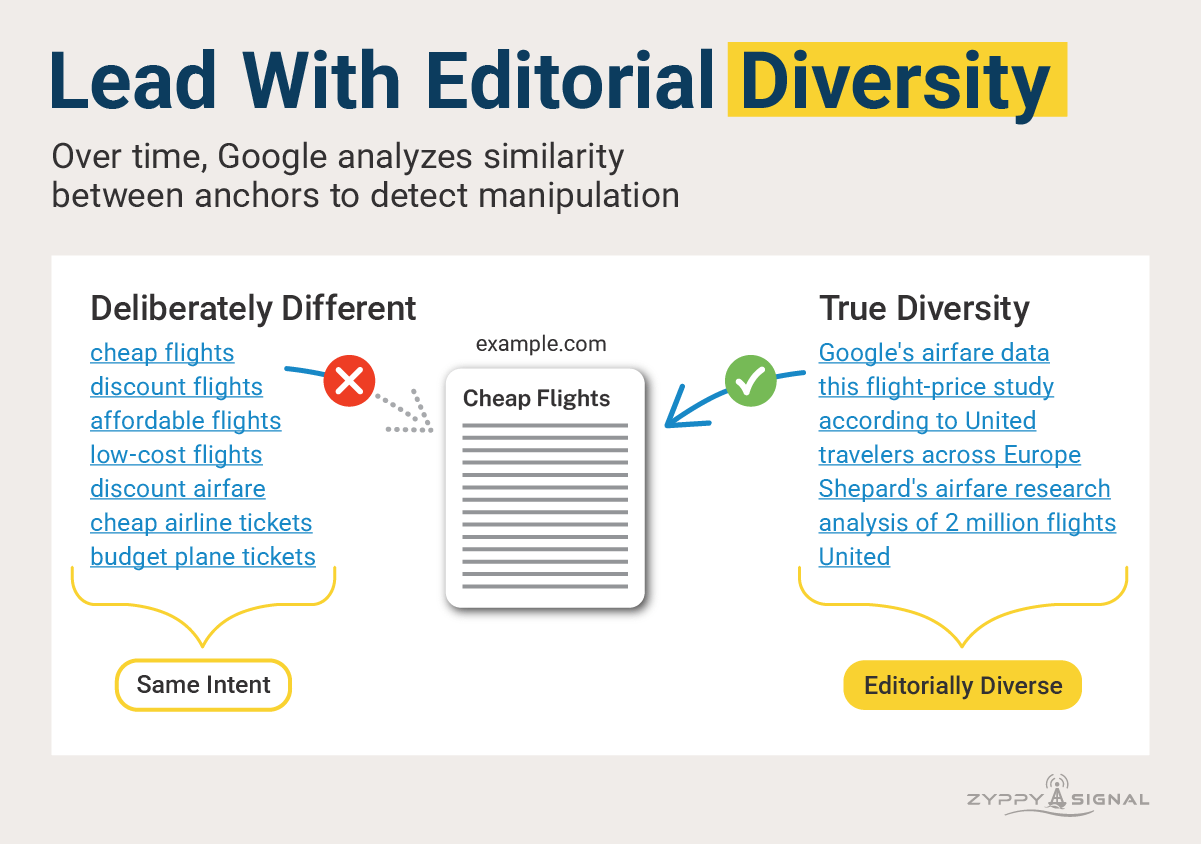
Multiple Google patents describe how Google can identify natural linking by tracking anchor-text words over time. This lets them spot hard-to-detect patterns and what they call “deliberately different anchors” meant to influence rankings.
For example, let’s say our client wanted to rank for “cheap flights.” They might ask us to build links like this:
cheap flights
affordable flights
low-cost flights
discount airfare
cheap airline tickets
etc., etc.
May seem smart, but over time, by measuring things like words, bigrams, and vectors, Google can likely identify such “deliberately different” anchors and label them as spam, or at the very least trust them less.
The Google API leak includes dozens of attributes related to spotting suspicious link patterns, such as phraseCount, phraseFraq, and spamProbability, among others.
Importantly, this isn’t an on/off switch. Lots of SEOs will say links like these absolutely work. Google can simply discount a link based on the likelihood of manipulation. To maximize link power, reduce any manipulation patterns Google might detect.
Instead of getting dinged for “identical/deliberately different” anchor text, a more natural distribution might look like this:
Google’s airfare data
this flight-price study
according to United’s analysis
Cyrus Shepard’s airfare research
an analysis of 1.2 million flights
United
Yes, these anchors contain fewer “money” keywords, but they are much less likely to be discounted in Google’s eyes, and each provides unique information.
Timing is important here too. If your SEO agency creates a bunch of these “deliberately different” links over a specific time period, Google can identify the spikiness of the pattern and discount appropriately.
It’s best to space out your efforts consistently over time.
4. Unique Links Almost Always Beat Repeating Links
Imagine a site agrees to link to you in their sidebar on every page of their website, 20,000 pages in all.
And they give you that sweet anchor text, “Best New York Plumbers”.
20,000 new links.
But Google may hardly count any of them.
Why? (Aside from lacking proper context!) Because Google doesn’t care about how many links, but how much new/unique information each link provides.
If links are votes, they want independent decisions.
A number of API attributes relate to this, such as anchorsDropped and totalDomainsAbovePhraseCap. Google’s documentation even states:
“If we receive a large number of anchors from a particular domain, then we’ll throw out all but 200 of them from that domain.”
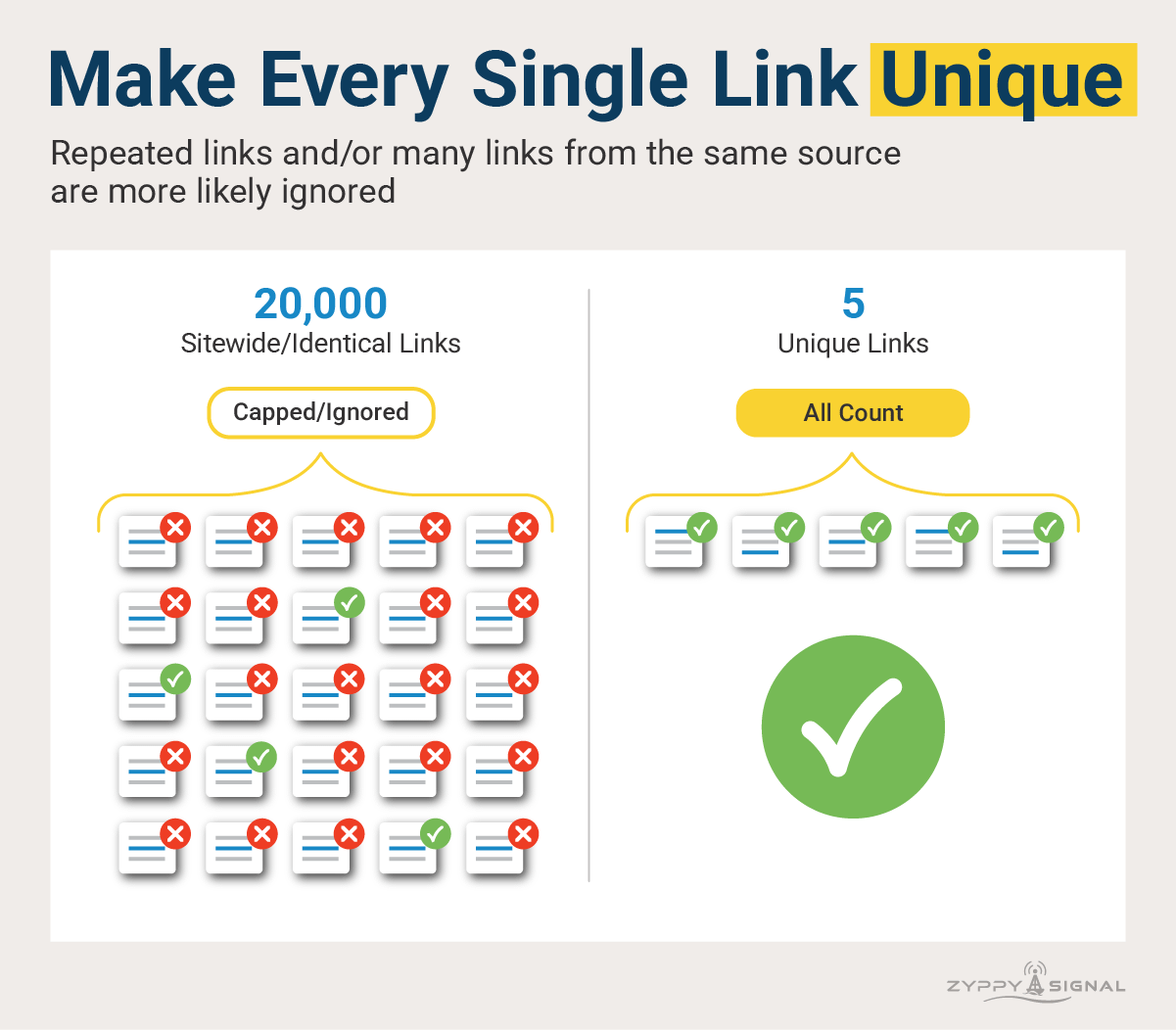
The earlier Google patent on “context” also described discounting links when the context was suspicious or identical. So these links may not have as much value:
Sitewide links
Mass syndication
Templated links
Repeating widget links
Instead, always prefer truly unique, independent links. Whenever possible, each link should provide new information.
A well-placed single link in a relevant article can outperform a million widget links that all say the same thing.
5. Redirects and Topic Drift Kill Link Power
Google keeps a very long memory about your link history and what your pages were about before you changed them. The API includes references to fields such as linkBeforeSitechangeTaggedAnchors and originalTargetDocid which directly target your link history.
Google patents say that if a site/page's focus changes over time, older links may no longer be considered relevant.
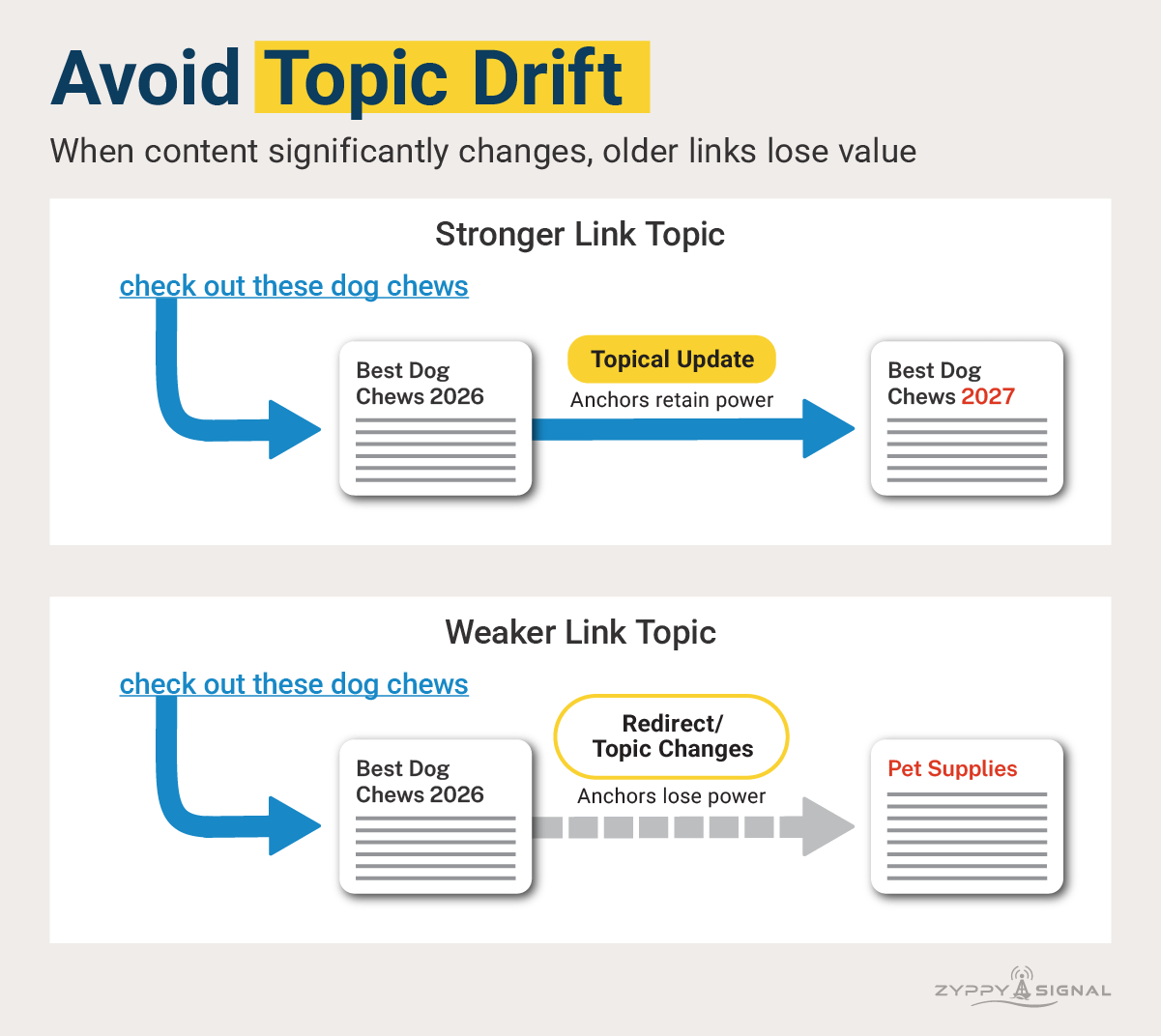
Even without redirects or content changes, Google may still ignore your anchor text if the text isn’t relevant to both the linking page and the destination.
If you’re simply updating your page from “Recommend Dog Chew Toys 2026” to “Recommended Dog Chew Toys 2027”, this isn’t a big deal.
But if you decide to kill that article and redirect it to your “Pet Supplies” category, Google is likely to discount the old links. This applies to many different situations.
URL migrations
Acquired domains
Repurposed pages
Expired-domain redirects
Aggressive 301 strategies
Often the change is well-intentioned, but harmful to rankings. We see this often with our clients. A high-ranking page is “updated” enough that its core focus changes, and rankings drop over time. Multiple factors can cause this, but loss of link equity is one of the less obvious ones.
The Core Principles of Building Bulletproof Links
Link building can be hard, hard work, but well worth the reward. In future guides, we’ll cover “how” to get the hardest-earned links.
For now, here’s our basic advice for the links you’re already building:
Always go after the highest-value link from established sources that you can afford to spend time, effort, and resources on. A truly trusted link can be more powerful than 100 weaker links, and can even lift those 100 links up in value. And if that great link is truly editorial (made by natural decisions, not because you paid someone), then that link can likely lead to multiple downstream links.
Pay as much attention to the words surrounding the link as to the anchor text itself. Give every link the rich, varied context it deserves, including surrounding words, headers, and page titles. Whenever possible, avoid repeating the same context.
It’s important to vary your anchor text, but avoid making them obviously “deliberately different.” If two anchors vary the same phrase with basically the same meaning, they may pass less value. Instead, make sure each anchor + link has a unique intent, and allow Google to treat each link uniquely.
Along the same lines, always prefer unique links that convey new information. Every time a link is repeated, the chance of it getting ignored increases.
While it seems obvious, every link should have a tight topical relationship flow between
Source URL → Anchor Text + Context → Target URL. If any of these are not topically relevant, it can break/weaken the chain. Be extra wary of redirects and content updates that shift topical focus (although these are often unavoidable).
Next: The Pro Guide to Building Great Links
Wait, there’s more?
Yep! Building links is a big topic. Our next post explores how to earn the kinds of high-value links Google is less likely to ignore, with real-world examples of what makes these links stand out. Subscribe for updates.
👋 Subscribe free (it helps us produce research like this) and get tips + tactics on how to win more SEO and AI visibility. Premium subscribers get 100% access to Pro Templates, Webinars, & Archives to level up your Marketing / SEO / AI skills.