


Home | AI SEO Marketing | Pro Templates
👋 Subscribe free (it helps me produce research like this) for proven tips + tactics on how to win more visibility in Google and AI search. Get SEO/AI strategies, new data, and frameworks delivered each week. Premium subscribers get full access.
Is your Google traffic rising or falling?
Business owners reach out to us almost weekly seeking “traffic recovery.” Typically, they’re hoping for technical SEO fixes or quick wins to turn their traffic around in a couple of months.
In reality, it’s their business model, user experience, or content production that’s killing them.
Google simply wants to give that traffic to a different type of site now.
The data support this. While it’s true that Google has decimated entire categories of publishers, other studies show that overall traffic declines are probably modest, and for every website losing traffic, there is often a winner.
What do these winning sites do differently from everyone else? Importantly, can we learn any strategies from them to protect and grow our own traffic?
To answer this question, I analyzed over 400 winning and losing websites, revisiting many of the same sites covered by Lily Ray’s excellent analysis of Google’s December update.
You can see the full list with updated traffic stats.
These include some very big movers over the past year, with a mix of recognizable brands and smaller players. We analyzed traffic trends over the past 12 months and then classified them by business model, content types, creator profiles, and other definable characteristics.
When we analyzed these features against winners and losers, very clear patterns emerged.
In short, Google has moved beyond simply ranking “good content” to proactively rewarding what AI can’t replicate.
5 Website Characteristics of Winning Websites
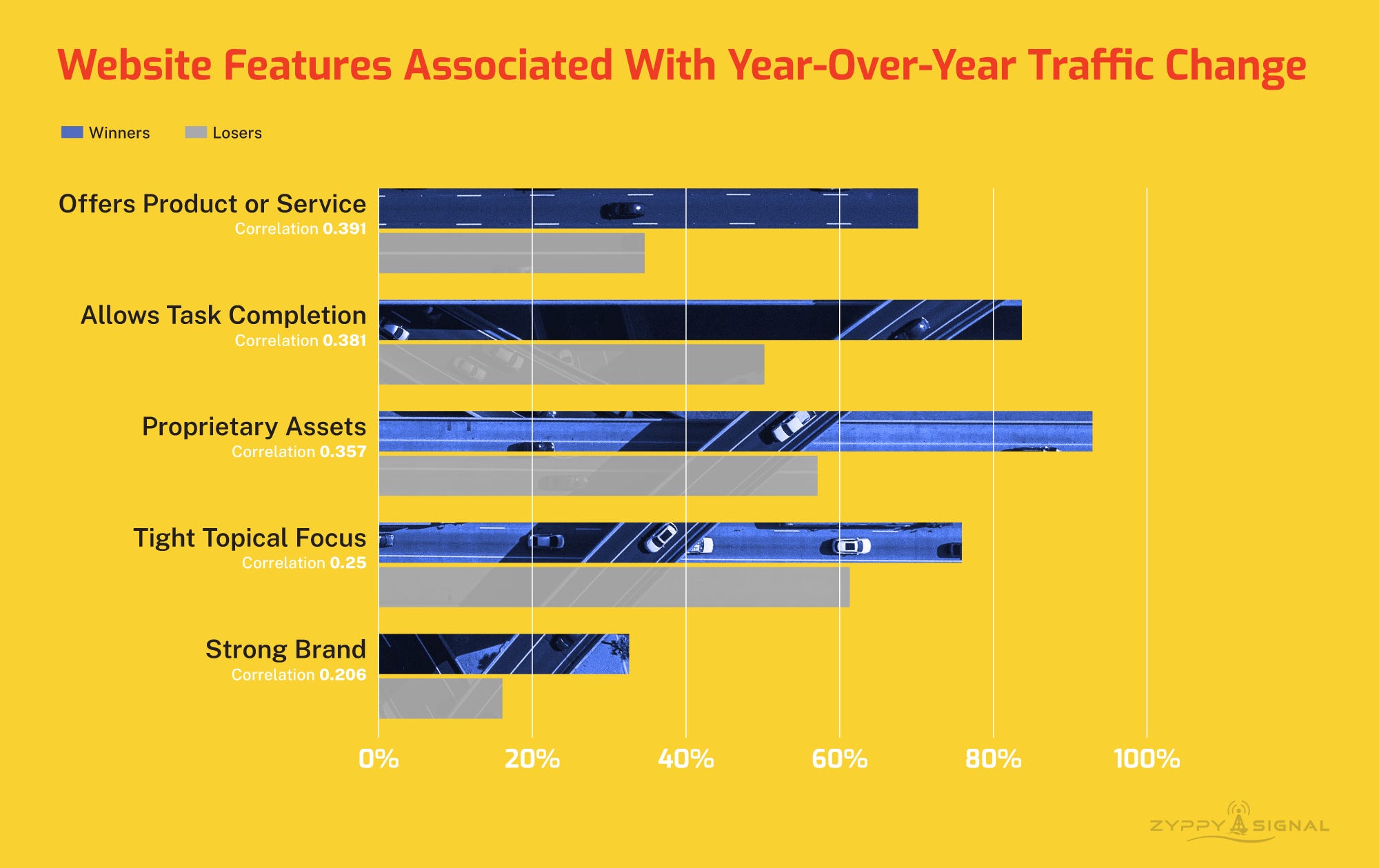
After crunching the numbers, we identified 5 features that very strongly predicted whether a site was winning or losing Google over the past 12 months. Here they are with their Spearman correlation.
Offers a Product or Service - 0.391
Allows Task Completion - 0.381
Proprietary Assets - 0.357
Tight Topical Focus - 0.250
Strong Brand - 0.206
Let’s dive into each to understand what they mean.
1. Offers a Product or Service
Winning Sites: 70.2%
Losing Sites: 34.6%
Offering a product or service was the highest correlated differentiator in our dataset. Sites that sold their own products performed especially well (as opposed to third-party platforms).
Losers tended to be news, informational, and affiliate sites.
Most interestingly, winners didn’t always sell a physical product. Service-based offerings did well, too, such as subscriptions and digital goods.
Winning Examples:
budgetbytes.com resembles other recipe sites but offers a subscription meal plan service.
mathnasium.com is a math tutoring site that offers online and in-person tutoring.
Losing Examples:
byrdie.com operates primarily as a fashion publisher with no real product.
medicalnewstoday.com is a large informational publisher, not a service provider.
Google says your content should have an “existing or intended audience” that doesn’t rely on search traffic.
Make it actionable: If you can position (or shift) your business model to make a proprietary product or service a core offering, that seems like a smart decision. It also helps build your brand, which we’ll discuss below.
Many website owners ask me if they can simply set up a webstore on their site to sell easy digital downloads. The answer is probably not. Sites that we see winning offer products and services as a core part of their business, not a hasty add-on.
Yes, it’s a big ask. Huge, in fact, with no guarantees. Travel blogs might become tour guides and offer vacation planning. But what else will they do when the Google traffic dries up, if it hasn’t already?
Here’s the good news: even if you don’t offer a product or service, there are other avenues to winning on Google.
2. Allows Task Completion
Winning Sites: 83.7%
Losing Sites: 50.2%
Task Completion means the website allows users to ultimately complete the task they set out to accomplish by searching.
Most losing sites may offer great information on topics, but the user needs to go elsewhere to actually do anything with it. WalletHub, for example, produces great credit card comparison pages, but the application process for those cards happens off-site.
You might think task completion has a lot of overlap with “Offers a Product or Service,” and you’d be right. If someone buys a pair of jeans at Levy’s, then they’ve completed their task.
But importantly, sites don’t need to sell anything to allow task completion. Consider these examples below.
Winning Examples:
mathisfun.com is a math tutorial site that offers interactive tools, quizzes, and workbooks, providing users a way to practice math.
stockanalysis.com acts as a complete research platform for stock analysis.
powerball.com allows users to check their lottery tickets from an authoritative source.
Losing Examples:
fortune.com explains business topics, but it is typically not where business takes place.
byrdie.com covers fashion products, but doesn’t offer a direct way to obtain those products.
Make it actionable: If you don’t sell products or services, offering useful tools and/or data is typically the next most effective step to help users complete their task. Examples include calculators, quizzes, searchable databases, and booking tools. The goal is to own the next step of the user journey.
3. Proprietary Assets
Winning Sites: 92.9%
Losing Sites: 57.1%
Proprietary Assets means owning something that other sites can’t easily replicate. This could be a unique product, special databases, user-generated content, software, reviews, or anything else of value that’s “owned” by the website.
Winning Examples:
letterboxd.com - Popular, fast-rising site that uses data from its large user base to graph movie popularity.
todaytix.com - Maintains an inventory of up-to-date theater ticket availability.
Losing Examples:
lifewire.com - Offers mostly tutorials and explainer-style content with a few “owned” first-party assets.
thespruce.com - Popular home and lifestyle blog, but with few first-party assets.
Make it actionable: For many sites, a good place to start is with the data and unique information you already have and turning it into an asset. This can mean original research, pricing surveys, aggregating reviews, original photo collections, or organizing your audience into a source of user-generated content.
4. Tight Topical Focus
Winning Sites: 75.9%
Losing Sites: 61.3%
When we originally analyzed “Topical Focus,” we found no difference between winners and losers.
But when we switched to “Tight Topical Focus,” the pattern became clear, because it seems Google is getting tighter with its selections, too.
Winning sites tended to be more niche, covering a single narrow topic more deeply and with more expertise. Losing sites, on the other hand, tended to cover topics broadly or only loosely related.
Winning Examples:
minecraft.wiki - Like Wikipedia, except only for Minecraft. Very tightly focused.
happiestbaby.com - Laser-focused on babies. If you are a baby, this is your site.
Losing Examples:
businessinsider.com - Covers business, but also entertainment, culture, and parenting.
newsweek.com - Perfect example of a broad publisher covering many verticals.
Make it actionable: Obviously, the play here is to become known as a go-to authority for a small handful of topics. It’s not uncommon to see hyper-specific travel blogs (e.g., “Vern Does Venice”) out-rank global travel brands. Specificity and deep topical expertise seem to be the way to win.
5. Strong Brand
Winning Sites: 32.6%
Losing Sites: 16.1%
First of all, what do we mean by “Strong Brand”?
Using Ahrefs data, we examined each site’s top 20 keywords and identified branded navigational terms. These are terms people use when looking for a particular site. For example, “mental floss” is an obvious branded search term for folks looking for mentalfloss.com.
We then scored sites as “Strong Brands” based on both the volume of branded navigational terms and the percentage of overall traffic they represented.
Sometimes a site can be highly recognizable, but almost none of its traffic is branded. These aren’t considered strong brands.
Winning Examples:
zoom.com - Extremely high brand visibility and lots of traffic from navigational queries
skims.com - A popular shopping destination that users seek out directly
Losing Examples:
lifewire.com - Highly recognized, but not a destination people actively seek out.
techtarget.com - A niche site known to many, but mostly attracts traffic from longer-tail keywords rather than people seeking it out.
Make it actionable: I could write an entire guide on building your brand in search (and I will - subscribe for updates!) Suffice to say, this often means shifting your marketing from keywords to your core assets: products, founders, company name, etc. Apple doesn’t advertise “computers”, but they know how to showcase a Mac. This is a challenging but essential shift, even for sites in boring industries.
The Additive Effect: Winners Possess More Core Features
Perhaps most interestingly, when we examined the data, we found that these features are additive.
Displaying only one feature wasn’t enough for a website to see the winner’s column; a site usually needed multiple features to win.
Offering task completion was good, but 1) offering task completion + 2) a tight topical focus +3) a strong brand was even better.
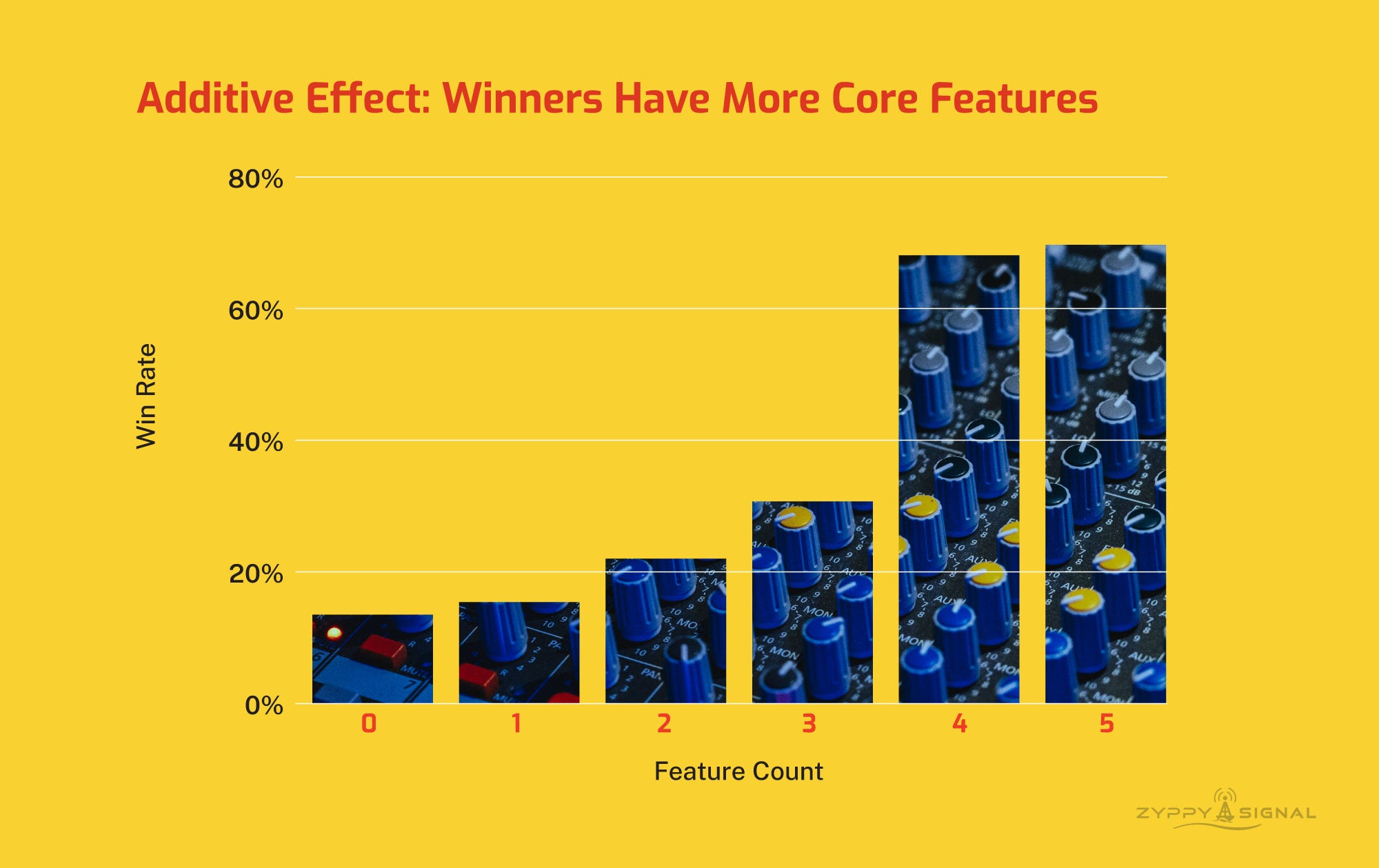
Here’s the win rate for various feature counts:
0 Features: 13.5%
1 Features: 15.4%
2 Features: 22.0%
3 Features: 30.7%
4 Features 68.1%
5 Features 69.7%
Other Features That Likely Help, But Didn’t Correlate
For this study, we also classified and studied a number of features we thought would be significant, but had no bearing on the data. These included:
Demonstrating first-hand experience or personal perspectives
Hosting User-generated Content (UGC) or community platforms
Uniqueness of information
I hesitate to include this information for fear that people will interpret it the wrong way. I don’t think these things didn’t correlate with success because Google doesn’t reward them, but more likely, they were already baked into the algorithm long ago. I suspect a larger data study would reveal interesting patterns here.
What Should Publishers Do?
Commodity content is dying, but not all commodity content is dying equally.
A winning site going forward has these characteristics:
It often offers a unique product or service.
It helps the user do something: buy, download, search, or book.
It stays within a niche topic of expertise, and it does it well.
It owns proprietary assets that are difficult to replicate: datasets, products, images, and UGC.
It becomes a destination site by positioning and promoting its own brand.
If you have an established business model, changing your focus and approach can be difficult.
We don’t know what search will look like in five years, but if you can offer something unique and help solve people’s problems in ways that aren’t easily reproduced, you have a good chance of finding yourself in the winner’s column.
Methodology - How We Gathered And Analyzed The Data
The dataset started with sites covered in Lily Ray’s analysis of Google’s December 2025 core update, which drew on Sistrix visibility data. Year-over-year traffic change for each site came from the Ahrefs API, measured over a 12-month window.
We then classified every site by hand against a fixed set of features, including business model, content type, creator profile, task completion, and proprietary assets. Each feature was recorded as a binary flag.
Brand strength also used Ahrefs keyword data. For each site we took the top 20 keywords, isolated the branded navigational terms, and scored sites on both the count of those terms and their share of total traffic.
To relate each feature to performance, we calculated Spearman rank correlations between the feature flags and 12-month traffic change. We used Spearman because it operates on ranks and tolerates the outliers common in traffic data.
These findings are correlational and rely on manual classification, so they indicate association and cannot establish causation.