

17 Content Types to Survive Google’s Zero-Click Future
No more generic blog posts. Plus Pro content frameworks for every type of publisher.

👋 Hi, I’m Cyrus. I write Zyppy Signal for anyone who wants to excel in marketing, AI, and SEO. Pro members get full access to every post and template.
For many websites, Google Zero is already here.
For others, it’s coming soon.
Google Zero, a term coined by Nilay Patel, refers to a time when Google Search stops sending traffic to third-party websites.
Google’s Zero-Click era has been creeping up on us for a while now. The latest data from Datas/Sparktoro shows nearly ~60% of Google searches don't result in clicks to third-party websites. With Google’s shifting algorithms and AI Mode looming on the horizon, entire publishing industries are being decimated.
When AI can answer any question instantly, what does that mean for the rest of us? Is there anything web publishers can do?
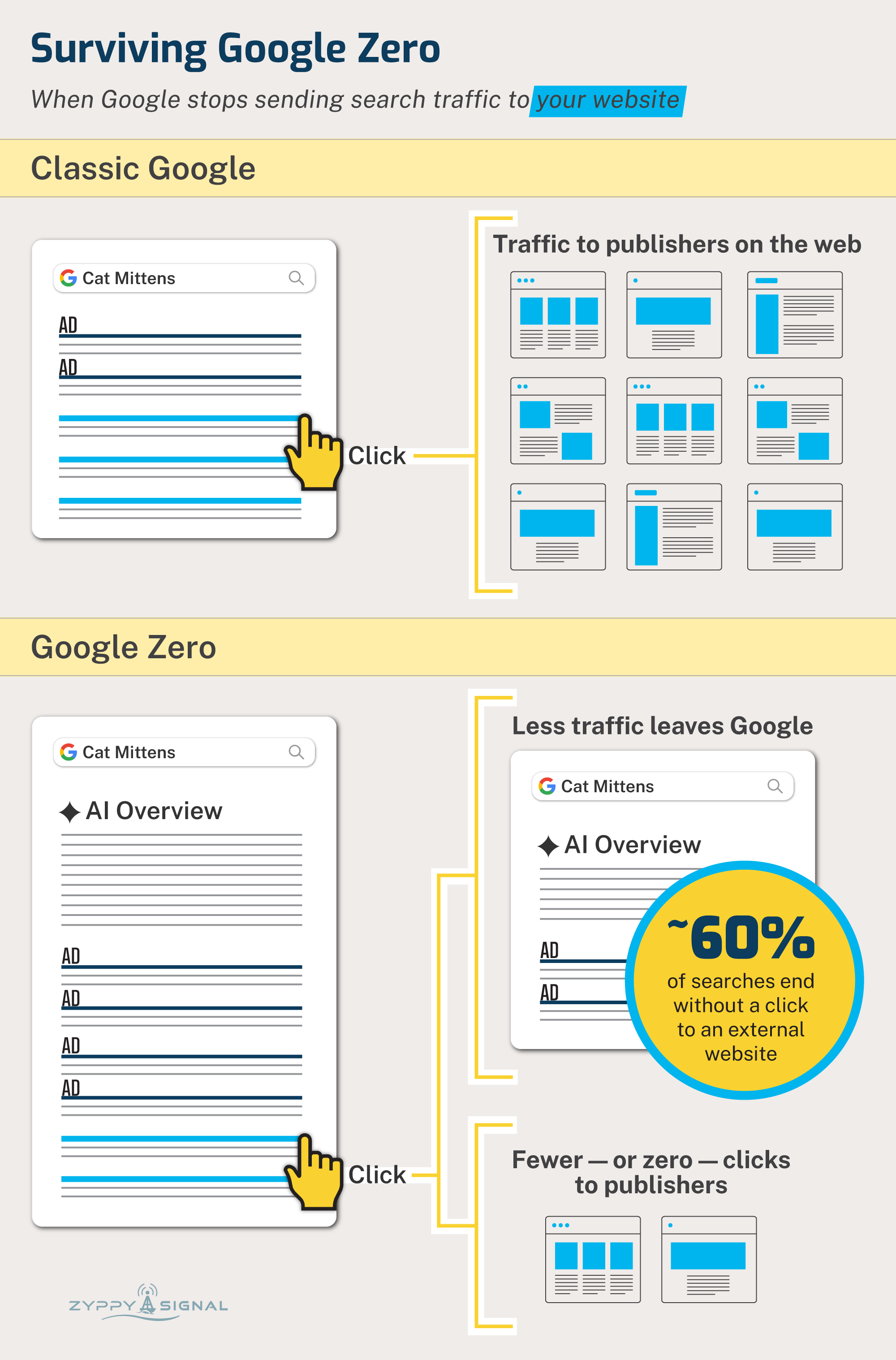
Here’s the truth: traffic isn’t completely going away, and it likely never will.
Google still sends billions of visitors to websites each day: visitors looking for specific websites, visitors looking to buy things, visitors looking to connect with other humans, and visitors looking to solve a million unique problems.
At the same time, fewer and fewer of those visitors are looking for generic information.
The days when businesses simply “published a blog” trying to rank with only “content and links” are behind us.
We know for a fact that Google favors different types of sites now. Winning content tends to be proprietary, unique, and solves problems beyond providing information.
Looking at 100s of winning and losing websites, parsing Google guidelines, and reviewing Google statements about the future of AI search, we cataloged 17 content types that currently perform decently-to-excellent in the AI era when properly executed, and in our judgment, are most likely to survive the next few years and beyond.
Many sites using these content types are positively thriving today.
Others will most likely be stable for the next few years, given the moats they’ve built.
Yet others will certainly see declines in Google traffic, but many may at least survive if they execute well.
This list of content types isn’t exhaustive. You’ll see other winning formats/strategies, but they generally share many of the same characteristics: winning content tends to be proprietary, experience-based, niche-focused, and allows task completion beyond merely providing information.
These 17 content types, in order to win, require those same characteristics.
These content types may look easy, but don’t be fooled into thinking that any of these are low-effort, at least when done well.
Before you hit publish—no, before you do any content strategy, consider where your content sits in one of these types.
Note: Please don’t consider these content types “get out of jail free” cards. When done with minimal or even above-average effort, you can still lose by producing a less-than-stellar output.
But they can help shape your content strategy in an increasingly zero-click world.So instead, think of these content types as starting points for your most excellent, first-in-class efforts at content excellence.
Let’s explore each type. At the end, we've included a Pro Framework to adapt these content types to different business models.
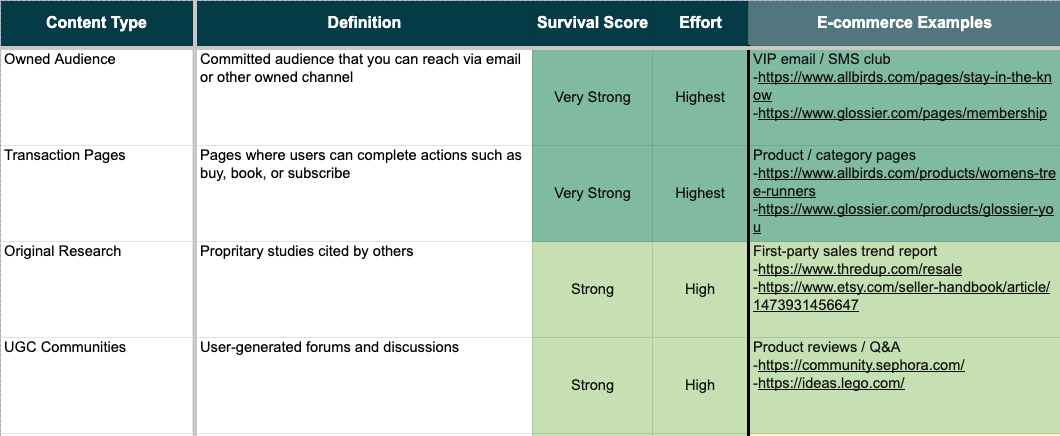
1. Owned Audience
Very Strong | Highest Effort
“Owned Audience” is more of a content strategy than a format, but it’s also the gold standard. Owning your audience distribution channels means you don’t entirely rely on Google. Conversely, it often means more people actually search for you.
Most owned audiences these days operate via email, but they can also work via SMS, in-app notifications, or even snail mail catalogs.
The key, of course, is having content people want to subscribe to and pay attention to.
If you’re asking, “Why would anyone want to subscribe to our boring blog content?”, you should instead ask, “Why is my blog content boring in the first place? Who are we publishing it for?”
Examples: Morning Brew, Stratechery, Lenny's Newsletter
2. Transaction Pages
Very Strong | Highest Effort
Transaction pages are more than simple product pages (though these count, too). Transaction pages help users “complete” an action, such as booking a hotel reservation or subscribing to a service.
In the future, agentic commerce may see AI agents shop on our behalf, so users never need to visit a website. Even in that scenario, we still need transaction pages, and for now, they remain some of the strongest zero-click pages on the web.
Examples: Hipcamp, Chewy, Sweetwater Electric Guitars
3. Original Research
Strong | High Effort
Original research goes beyond publishing mere facts and data, as it must be unique and proprietary. This is research you originated, born of your own hard work.
It’s true, AI answers can cannibalize your original research, but they are much more likely to cite it, and users often want the original source.
Perhaps more importantly, original research is often cited by others—including journalists—and this can generate significant trust and authority signals for Google and LLMs alike.
Examples: ChartMogul Insights, Carta Data, Orbit Media Blogging Statistics
4. UGC Communities
Strong | High Effort
Forums and communities serve a dual benefit:
Engaged members seek them out to connect with like-minded users, providing built-in Google Zero protection.
They generate a lot of experience-based content, which Google currently favors.
Building a community is hard, hard work. But those that invest in their users have seen outsized rewards in the past few years.
Examples: Flyertalk Forum, Mumsnet Talk, Rick Steves Travel Forum
5. Creator Video & Podcast
Strong | High Effort
We live in a “Hot Ones” attention economy.
The point of Creator Content is not simply to pump out videos and podcasts on a topic. It’s about the host, brand, or format itself that makes the content unique.
My family used to listen to Car Talk on NPR, not because we cared about car repair, but to listen to the two cranky, funny hosts. When your creator content is so good that people search for you by name, you’ve made it.
Examples: Practical Engineering, @mkbhd, @Fireship
6. In-Depth Reviews & Tests
Strong | High Effort
We learned a lot from Google’s Helpful Content update, which saw many review websites lose significant traffic (though not so much for YouTubers). Google’s always been a little suspicious of commission-supported product reviews, but consumer demand is consistently high.
Winners in this category typically review products in great depth, with firsthand evidence, repeatable testing protocols, side-by-side comparisons, teardowns, and high-quality photos and videos.
AI answers can summarize these reviews, but they can’t replicate the firsthand evidence many users seek before buying
Examples: RTINGS: TVs on the Market, BabyGearLab Jogging Stroller, Tom’s Hardware CPU Benchmarks
7. Brand Pages
Strong | Low Effort
Most websites publish an “About” page, but in the age of AI, that’s hardly enough. While search engines, LLMs, and users can learn about you through third-party sources, what you say about yourself is often the most important.
Consider these different types of brand pages:
About: Company, Leadership/Author Bios
Trust: Editorial Policy, Legal, Values, Privacy
Social Proof: Press, Testimonials, Case Studies, Reviews
Contact and Support
These pages aren’t always sexy, and they don’t typically drive a ton of traffic, but they are absolutely foundational to establishing trust and defining your entity.
Examples: Buffer About, Bankrate Editorial Policy, Sleep Foundation Editorial Policy
9. Directories & Databases
Moderate | High Effort
We need to be careful here, because some people may hear “build a directory” and think they’ll rank easily.
Sadly, this is not the case.
As with everything else on our list, directories and datasets typically need to be supplemented with proprietary, first-party information. This is the AI moat. Freshness is another critical feature, as users typically want the latest information.
Examples: AlternativeTo, Clutch, Nomads
10. Expert Perspective
Moderate | Medium Effort
Moving from facts to opinion, audiences often seek out expert perspectives on important matters. Stripe’s Cheeky Pint interview with Google’s CEO, which we mentioned earlier, is a perfect example of this.
Expert perspectives can earn citations and boost your brand. They also work best when anchored with unique experience and insider information/data.
Examples: a16z News Content, Not Boring, Tom Tunguz
11. Templates
Moderate | Medium Effort
Reusable templates are frameworks that users can download or reproduce in order to get started, speed up work, or accomplish a specific use case. Consider Canva templates, which helped explode growth for the company.
Obviously, the harder the templates are to replicate, the more valuable they become. And templates tied to a particular software or physical product help with both lead-gen and retention.
Examples: Miro Miroverse, Airtable Templates, SlidesCarnival
12. Case Studies
Moderate | Medium Effort
We love case studies. Case studies typically don’t drive a ton of traffic, but they support conversions and boost the brand. A good case study shows how a product, service, or process got results.
One thing: most case studies we’ve looked at underdeliver. They tend to be more promotional than instructional.
To win, you want to display a clear before-and-after result, expose as many metrics as you can, and clearly explain the process.
Examples: Vanta Customers, Webflow Customers, Shopify Case Studies
13. Original Reporting
Moderate | High Effort
Reporting is a tough gig. News publishers have seen a steady decline in Google search traffic year after year. AI answers that summarize news events make things even worse.
That said, there’s still a place for original reporting in an AI world. AI can summarize commodity news, but original reporting that is fast, in-depth, or exclusive can still earn citations and visits.
To keep beating the same drum, like every other content type on this list, Original Reporting needs to add deep value beyond the same information that everyone else reports.
Examples: The Information, The Verge Tech, Reuters Technology
14. Support and Document Pages
Moderate | Low Effort
Support and documentation pages aren’t always sexy and don’t always drive a ton of traffic, but like brand pages, online product companies absolutely need them as a foundational layer for search and AI.
AI may summarize your API endpoints, but you want users to reference and seek out your canonical documentation. Well-documented help and support pages help LLMs learn about your product.
Finally, public support forums, like Adobe’s here, can be a great way to scale documentation
Examples: Plausible Docs, Mux Docs, Supabase Docs
15. Guides & Explainers
Weak | Medium Effort
On one hand, guides and explainer content are at high risk of being supplanted by AI summaries. ChatGPT can easily explain to me what a CRM is. On the other hand, niche explainers and in-depth guides often work when backed by brand expertise and proprietary data.
The key is to leverage differentiation to help users understand a topic. This differentiation can take the form of unique data (e.g., Examine’s Evidence Grades) workflows, comparisons, or expert content hubs.
Elevate your guides and explainer content in a way AI can’t replicate.
Examples: Nerd Fitness Start Here, Examine Creatine, HubSpot What Is CRM
16. FAQs & Glossaries
Weak | Low Effort
Definition, FAQ, and glossary pages are among the easiest to produce and to replicate with AI. That said, they still work well when you can establish them as the canonical definitions for an industry.
For example, if I’m learning DNS, I’m more likely to seek out and trust the latest from Cloudflare over an AI Overview.
FAQs and glossary pages also provide a surface for building reference hubs, adding internal links to important product pages, and paths to customer support.
Examples: Moz Glossary, Cloudflare What Is DNS, Agile Alliance Agile Glossary
17. Lists & Roundups
Weak | Low Effort
Curated “Best of” and “Top 10” lists have gotten a lot of flak recently, and deservedly so. Marketers are using fake lists, with themselves at the top, to manipulate AI-generated answers and recommendations.
But Google and AI answers generate a lot of lists and recommendations for a reason: people really want them.
Like every other content type on this list, the standards for winning with lists and roundups in Google search are incredibly high - especially for competitive terms. Google has shifted to favoring original testing, published scoring criteria, and hyper-niche focus.
Examples: ICAgile Project Management Software, Website Planet Builders, IRunFar Best Jogging Strollers
Pro Bonus: Content Frameworks for Specific Business Models
By this point, I hope we’ve convinced you to stop publishing commodity blog posts, but what should your specific business actually tackle?
To help, we created a publishing rubric for Pro Subscribers covering these content types with examples for many different business models/websites:
Saas
Affiliates
E-commerce
Local Services
Media/Editorial
Marketplace/Directory
These frameworks available via the link below can help marketing teams rethink their content strategies and plan more resilient, more purposeful content roadmaps.
Keep reading with a 7-day free trial
Subscribe to Zyppy Signal with Cyrus Shepard to keep reading this post and get 7 days of free access to the full post archives.