


Home | AI SEO Marketing | Pro Templates
👋 Subscribe free (it helps me produce research like this) and get the 7-Step AI Citation Checklist with tips + tactics on how to win more AI visibility.
Google says, “good SEO is good GEO”, but is this true?
I don’t disagree. Nearly every single good SEO strategy, properly executed, can help you with AI visibility.
That said, the reverse statement we sometimes hear, “GEO is just SEO,” is harder to defend.
AI has opened up new optimization surfaces and activities (like Garrett Sussman using email to influence Google Personal Intelligence AI or Dejan building the excellent AI Brand Authority Database) that simply didn’t exist in the previous era of traditional SEO.
At this point, you might suspect I will argue in this post that SEO and GEO are separate disciplines that require distinct strategies.
Not today. Today I play my own devil’s advocate.
After spending the past few months deeply researching how AI engines generate recommendations and cite sources, I’m even more impressed by how well traditional SEO practices support AI visibility. In many cases, more than most marketers may realize.
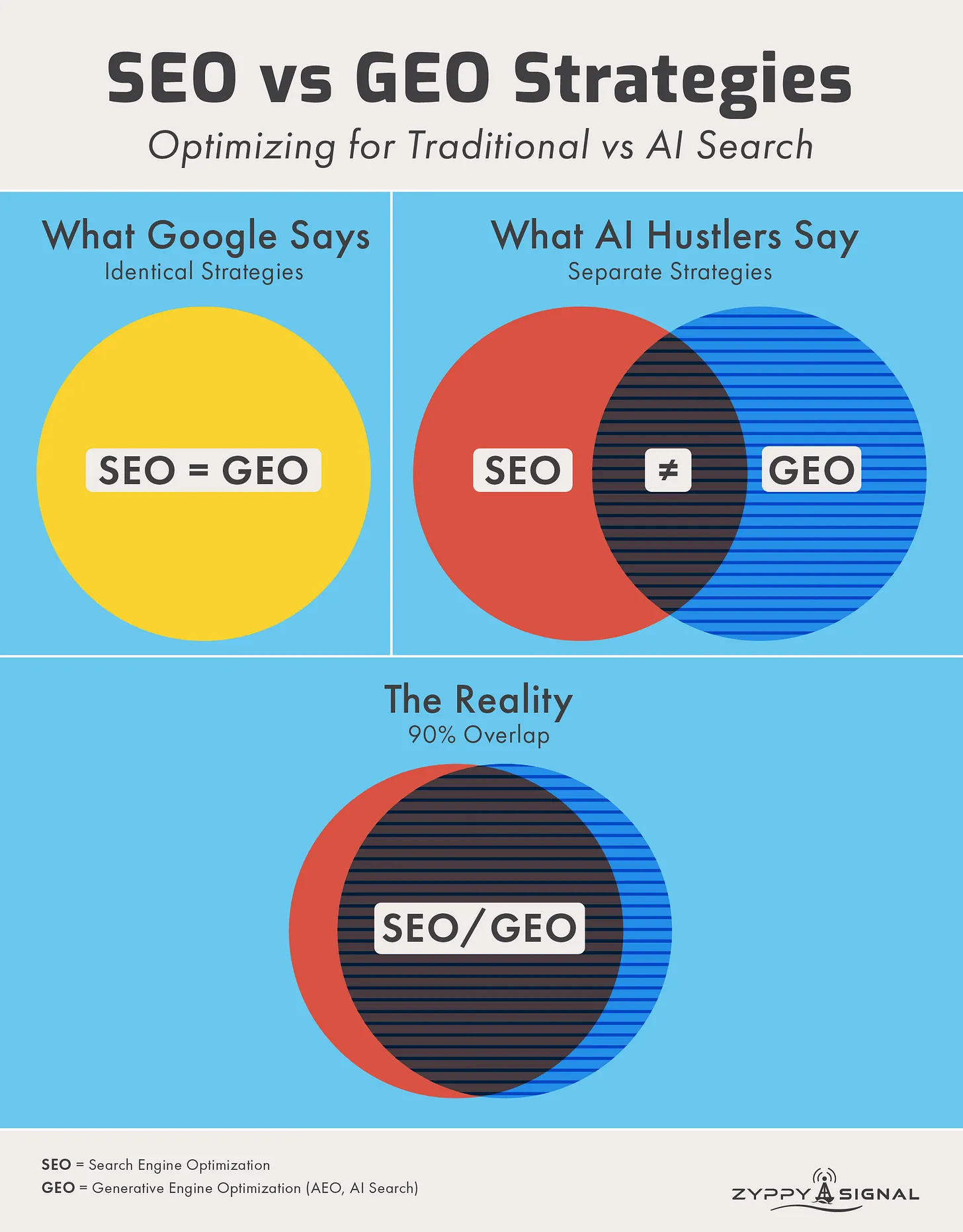
Does your business need a separate and dedicated GEO strategy to win AI visibility? For the vast majority of websites, almost certainly not. You definitely don’t need to pursue unproven AI trends antithetical to traditional SEO that can later bite you in the butt.
You don’t even need an llms.txt file. At least not yet.
No, the most powerful AI levers already sit beneath your nose.
This isn’t to say that advanced AI tactics aren’t worth pursuing. Some of the smartest operators in the industry are pursuing them with success. For the rest of us mortals, you can achieve 90%+ of your AI visibility goals by:
Adapting to modern SEO fundamentals
Tweaking SEO tactics to target specific mechanisms of AI search
Broadly, here are 3 AI visibility goals most businesses hope to achieve, and the specific SEO levers that get you there.
1. Make Your Content AI Eligible
First and foremost, if you want content from your website to be considered by AI, the AI system needs to be able to crawl and understand your site.
Google itself has been perfecting this for over 30 years. Indexing and crawl control are bedrocks of SEO, so much so that many people consider it a “solved” problem.
When’s the last time you thought about your robots.txt file, or soft 404s? Good SEOs are constantly reexamining these files and reports. The fact that so many people consider it “solved” is part of the AI challenge, and the opportunity.
The AI Twist
You might assume that if your site shows up in Google, you’re good as far as AI crawlability is concerned. But consider the following complexities:
Robots.txt directives have become far more complex, with new user agents appearing every few months. Many organizations block some AI agents while allowing others. These rules are often put in place by technical teams with little communication with the affected marketing teams.
CDNs and platforms like Cloudflare can also manage AI access with advanced bot control rules.
Snippet control directives like
data-nosnippetcan impact what content appears in AI answers.While Google maintains a very large index of the web, AI often builds its data from other seed sources, such as Common Crawl, which many websites may inadvertently block.
Many AI crawlers don’t routinely render JavaScript, potentially making some of your content invisible.
All of these can be addressed with (mostly) traditional SEO levers. But adding AI control to the mix adds complexity that likely needs to be audited and optimized far more often.
The SEO Levers To Use
Audit your robots.txt file aggressively for AI bot access, while keeping in mind that AI crawlers don’t always respect robots.txt. Understand the difference between training bots, search bots, and user-triggered bots. For example,
OAI-SearchBotis used for search, whileGPTBotandGoogle-Extendedwork mostly for training. Finally, users can trigger visits to your site with user agents likeChatGPT-User.Bot Control: Make sure your CDN, firewall, and bot-management platform enforce the same policy as your robots.txt file. Check platforms such as Cloudflare for broad “block AI bots” rules, which can check legitimate crawlers using both their user agent and IP ranges.
Make sure the text you see on a webpage is the same as what AI bots can see without a lot of JavaScript rendering. The AI Difference Engine extension from Gray Dot Co can help with this.
Snippet Control: Check for any
noindex,nosnippet,max-snippet, anddata-nosnippetdirectives you may have in your HTML. These originally controlled how your site appeared in Google results and can still impact your AI visibility today.
Counterpoint: More access is not always the solution. Many publishers are pushing back at unlimited AI bot access, which our friend Shahzad Abbas brilliantly argues is necessary.
2. Win AI Citations
When AI answers appear, they often include citation links to external websites to support the answer.
While the evidence we have suggests these citation links don’t get a ton of clicks, other research shows that AI citations can significantly boost traditional organic and paid clicks to brands that win them.
A lot about earning AI citations is simply ranking highly for the main search, but it can be a bit more nuanced than that.
The AI Twist
In addition to ranking for the main term, AI systems use fan-out queries (subqueries that AI performs in the background). Many studies confirm that ranking highly in organic search for fan-out queries is correlated with more AI citations.
Through a concept known as Reciprocal Rank Fusion (RRF), there is evidence that the more fan-outs you rank highly for in organic search, the greater your chances of getting cited by AI.
AI isn’t always looking for an answer; it’s often looking for content that already supports the answer it’s already formed. In these cases, content that matches what the AI already knows may be more likely to get cited.
Increasingly, instead of looking at top-ranking results, AI engines look to authoritative sites when researching specific answers. Sometimes this is outside your control, but we’ll discuss “Get Recommended” below.
What’s interesting here is how much traditional SEO levers influence winning more AI citations.
The SEO Levers To Use
The best strategy for earning more AI citations is to find a keyword you already rank for and work to rank for query fan-outs for that keyword. I wrote a whole guide about it you can use here.
You can use special tools to find specific query fan-outs for on-page content, but they are often closely related to People Also Ask questions, which can save you time.
In my experience, it’s typically easier to rank organically for fan-out queries on existing pages (and typically more effective) than creating new pages for every question.
Keep in mind that AI systems are looking for evidence. This means certain types of content like specific claims, data, and evidence-backed data make attractive citation candidates.
Formatting matters. Since the AI is often looking for specific information, matching your headings and content to fit the question can help earn more citations.
3. Get Recommended by AI Answers
Ranking is nice. Citations are nice. But neither of these ensures that AI systems will actually recommend you.
That’s because AI engines build their recommendations based on multiple factors: their existing knowledge, top-ranking results, and multiple fan-out queries from trusted sources among them.
Think of it as “distributed consensus” - the idea of multiple trusted sources supporting the same conclusion.
The AI Twist
SEOs have engaged with third-party websites for decades through link building and digital PR, but the emphasis has shifted slightly from followed links and keyword-rich anchor text to authentic brand mentions.
Getting links and mentions from topically relevant sites was always important, but with AI, the focus is shifting to sites with genuine expertise and authority.
User-generated content from sites like Reddit and LinkedIn can have outsized influence if those pages rank highly for related queries, which they often do.
Third-party reviews played heavily into the decision layer, but with AI reading these reviews before your customers do, they have outsized influence in the initial recommendation layer.
While it may seem that winning AI recommendations is all about third-party mentions, that’s not always the case. While it’s true that what others say about you is typically more important than what you say about yourself, what you say about yourself may still carry a lot of weight.
The SEO Levers To Use
Start internally. Nail your brand position and facts, e.g., [Brand] is a [product] designed for [audience], especially good for [use case], because of [differentiator].
Make your brand facts consistent across all surfaces you control: your homepage, about pages, product pages, partner sites, employee bios, social media platforms, press releases, directories, etc.
Build up profile facts on third-party platforms. This could include company subreddits, YouTube channels, industry directories, marketplaces, review sites, app stores, and more.
Encourage detailed, authentic reviews. Customers who describe the problem you solved for them potentially carry much more weight than a simple 5-star review.
Invest in digital PR. Instead of focusing on keyword-rich, followed links, focus on authentic mentions that support your brand positioning.
Obviously, these strategies and tactics only scratch the surface of what can be accomplished with AI optimization and visibility via traditional SEO levers.
If you or your company needs expert help, check out our recommended AI Search agencies and consultants.
What’s currently working for you with AI optimization?