


👋 Subscribe free (it helps me produce research like this) and get tips + tactics on how to win more SEO and AI visibility.
For marketers, Google’s AI answers open up entirely new search surfaces, yet many people still don’t understand how it recommends specific websites and brands.
To find out, we asked over 130 search experts, many at the very top in the industry, a series of questions specifically about ranking in AI answers.
Their answers—and comments—revealed a huge number of AI ranking insights, including:
Brand and Trust outweigh AI-specific factors: Experts generally agreed that what Google knows about and trusts your brand weighed more heavily than AI-specific tactics like “chunking” or llms.txt files.
Parametric memory, or what the LLM already knows about you, is one of the biggest factors and one of the hardest to influence, at least quickly.
Specific evidence wins. Nearly all experts agree that original data, citable information, and specific facts beat generic information. Connecting the data dots for AI engines is a winning strategy.
Google AI visibility significantly overlaps with traditional SEO. “Crawling and AI eligibility” factors scored high in the survey, which opens up specific technical considerations. Respondents also found a positive overlap between ranking high in traditional results and Google AI visibility.
Additionally, they shared plenty of practical advice for moving the AI needle. Let’s dive into the data…
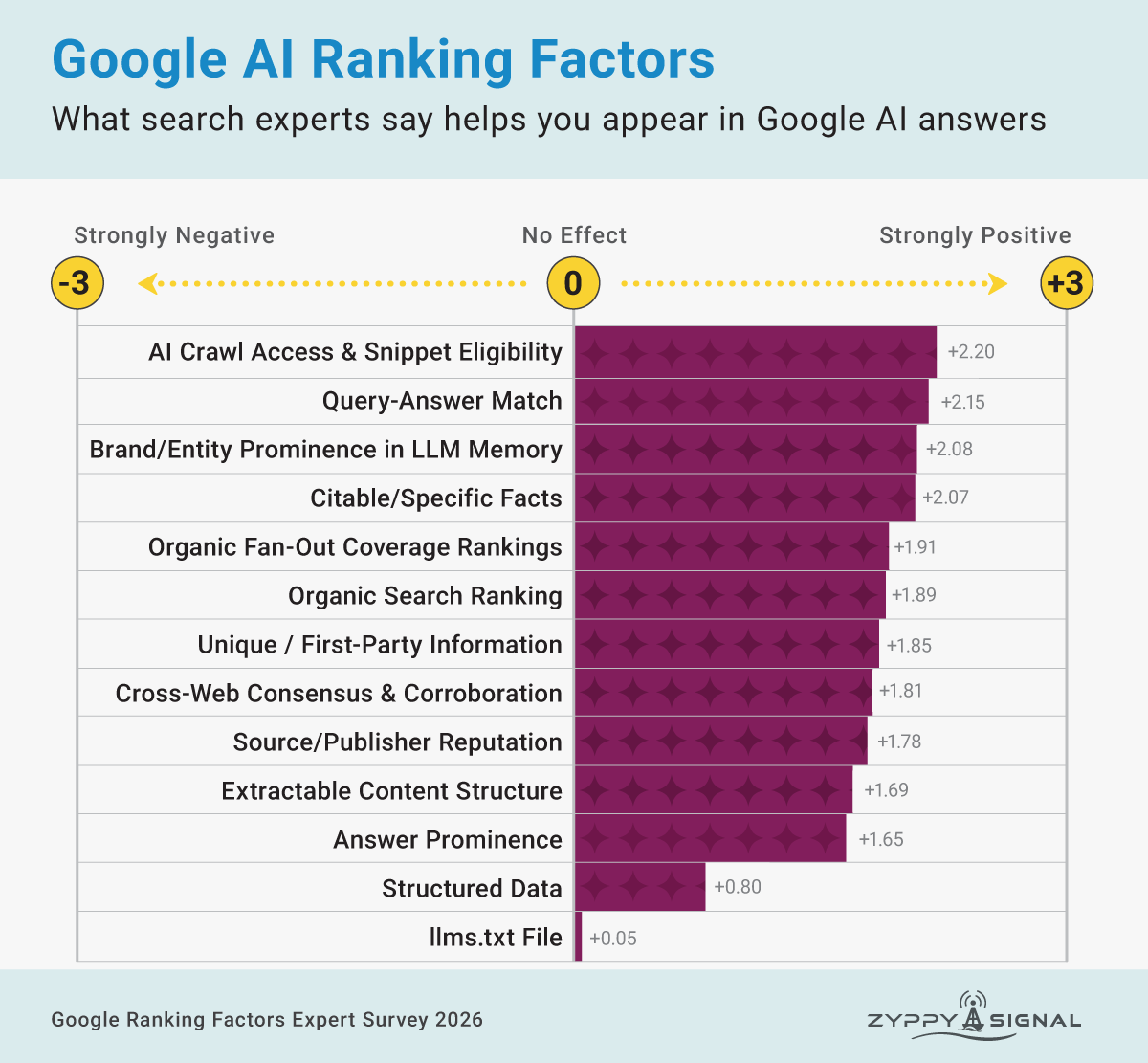
How We Rated Google AI Ranking Factors
For each potential Google AI “ranking factor,” we asked respondents, “How much do you believe each factor affects whether a page or source is surfaced, selected, or cited in Google AI Overviews or AI Mode?”
Respondents then rated each factor on a 7-point scale, from +3 (Strongly Positive) to -3 (Strongly Negative).
Finally, respondents submitted open-ended responses to further elaborate and refine their answers.
1. AI Crawl Access & Snippet Eligibility: +2.20
Definition: Whether Google can crawl the page and is allowed to use its content in snippets or AI-generated search features.
While Google can recommend your brand even if it can’t crawl your website, getting your content crawled and indexed goes a long way for AI inclusion. This is especially important as Google introduces new user agents and content exclusion tools.
“Access works as a hard gate ahead of any ranking consideration.”
- Fili Wiese, Search Brothers
2. Query-Answer Match: +2.15
Definition: How directly the page answers the user’s query or the specific question Google is trying to resolve.
Interestingly, “Search Intent Match” was the #1 ranking factor in our survey of traditional Google ranking factors. The same applies here — pages/passages that closely match the user question are more likely to be cited and included.
“Query-Answer Match: without a query-answer match, there is nothing to cite!”
- Natzir, Natzir
3. Brand / Entity in LLM Memory: +2.08
Definition: How strongly the brand, person, or entity is represented in the model’s existing knowledge.
If you’re a recognized brand/entity, the AI system likely already knows about you from its training data. How much Google’s AI system knows about you in its parametric memory plays a significant role in whether it recommends you in AI answers.
“One thing that really stands out with AI influence is the model’s parametric memory (what I call primary bias) which pulls towards or pushes against recommending a brand, product or service. For example Gemini hates Chinese brands. Don’t believe me? Look it up here. Even if you’re a grounding source, if you don’t have the model’s love you won’t be recommended as much. Entering the model’s training data is hard to do on your own, much harder than link building.”
- Dan Petrovic, DEJAN
“The next frontier of SEO is training LLMs to love your brand and making them biased to recommend you.”
- Diego Ivo, Conversion
“Memory is the sleeper variable in AI ranking that most brands are ignoring.”
- Ross Simmonds, Foundation
“You first need to be considered to be included in the fan-outs. That’s memory-based (or personalized for logged-in LLM users).”
- Jan-Willem Bobbink, GSC Wizard
4. Citable / Specific Facts: +2.07
Definition: Clear facts, statistics, or details that an AI answer can cite.
If you want AI to say nice things about you, you need to give it evidence for it to cite. Clearly identified facts or details about your brand can go a long way.
“Citable/Specific Facts and Unique/First-Party Information are evaluated separately here, but when they’re combined it is particularly powerful in earning citations. A specific number that’s already everywhere is not helpful to earn a citation. Specific and unique facts or data points are a path of less resistance to citations.”
- Geoff Kenyon, Pomar
“If AI search already has ten pages saying roughly the same thing about a topic, page eleven needs to bring something those ten didn’t. Original data, a test somebody actually ran, a firsthand observation, a process with a name and steps. That’s what gives a retrieval system something to cite.”
- Melissa Popp, RicketyRoo
“In an AI answer, being correct only matters once you are also easy to quote and impossible to replace.”
- Nitin Manchanda, LinkedIn
5. Organic Fan-Out Coverage Rankings: +1.91
Definition: How well the site or page ranks for related subqueries Google may generate for an AI search.
When someone searches with Google AI, Google may run multiple related fan-out queries to help answer the question. Ranking highly in Google results for these fan-out queries is associated with better AI visibility.
“AI Overviews and AI Mode run on retrieval-augmented generation grounded in the core Search ranking systems, with query fan-out generating related subqueries behind each response. The consequence is direct: pages get cited because they rank, either for the visible query or for the fan-out queries underneath.“
- Fili Wiese, Search Brothers
“Organic Fan-Out Coverage Rankings: Ranking good for the subqueries is literally how you get in.”
- Natzir, Natzir
6. Organic Search Ranking: +1.89
Definition: How strongly the page already ranks in Google’s traditional organic search results.
While our experts rated ranking fan-out queries as slightly more important, ranking in organic Google results for the main query came in almost equally important.
“Organic plays a massive role in AIO/AIM RAG as it’s one of the few models that retrieves for every interaction.”
- Jamie Indigo, Not a Robot
“AI citation/source selection changes the unit of optimisation from simply ‘rank the page for the query’ to ‘be the best supporting source for one or more information needs generated by the query.’”
- Maryanna Franco, — Maryanna Franco
7. Unique / First-Party Information: +1.85
Definition: Information unique to the source, such as original data, reporting, tests, or firsthand evidence.
Saying the same thing as everyone else using common facts isn’t a great way to get noticed by AI. Consensus is important, but Google increasingly rewards unique, first-party information.
“Unique first party information is something everyone should be investing in. This is something that will need to be cited by LLMs, will illustrate value to users and will show your expertise as a practical resource.”
- Crystal Carter, Wix
“Anything that isn’t in an AI or LLM they would want to gobble up, so it would stand to reason that sharing something they don’t know - Unique would be a good way to set yourself apart.”
- Jess Joyce, Jess Joyce
8. Cross-Web Consensus & Corroboration: +1.81
Definition: How consistently sources across the web support the same facts.
If you say your brand is amazing, but 99 other sites say you’re wrong, AI is unlikely to trust you. So even though “unique information” is important, so is agreement about basic facts.
“The consensus thing can be a trap. How do you offer information gain if you're saying the same thing everyone else is? And what if everyone else is wrong?”
- Everett Sizemore, Everett Sizemore
9. Source / Publisher Reputation: +1.78
What it means: The reputation or authority of the publisher, apart from the individual page.
In traditional SEO, site/domain authority is an important signal Google uses to rank results. Most of our experts believe Google AI uses a similar system of trust when forming answers.
“Grounded systems cross-check claims across the retrieved set, so unique claims from unknown publishers get skipped while unique data from trusted sources gets cited. Reputation resolves this tension.”
- Fili Wiese, Search Brothers
“Entity identity decides whether the engine is willing to lift it from you rather than somebody else.”
- Jason Barnard — Jason Barnard
10. Extractable Content Structure: +1.69
Definition: How easy it is to pull useful answers, passages, or data from the page.
Fun fact: Our experts mentioned “Chunking” (the concept of breaking content up into digestible parts for AI) a total of 8 times, but almost all agreed that you don’t need to chunk your content for Google to understand it.
That said, clearly organized content (e.g., headers, tables, lists, proper sentence structure) remains hugely important.
“Placement decides whether a passage can be lifted cleanly.”
- Jason Barnard, Jason Barnard
11. Answer Prominence: +1.65
Definition: How prominently the answer appears on the page, especially near the beginning.
In traditional SEO, many believe that answers near the beginning of the page can carry more weight. This same preference may carry over to AI answers.
“First, answer the query head-on and structure the answer so the system extracts it without effort.”
- Fabio Ricotta, Agência Mestre
“Humans and machines like quick answers to their Qs.”
- Will Scott, Search Influence
12. Structured Data: +0.80
What it means: Machine-readable markup that helps identify page content and relationships.
It seems like there’s a new debate every week about whether AI systems read or use structured data. We know that Google specifically uses structured data to understand web pages in organic rankings, and it likely has at least some influence on AI answers as well.
“The exception is product and merchant data, which feeds the Shopping Graph and does real work in AI Mode shopping results.”
- Andy Chadwick, Andy Chadwick
13. llms.txt File: +0.05
What it means: A proposed text file intended to give AI systems guidance about a site’s content and resources.
The sentiment around LLMs.txt files was… not great.
“An LLMs.txt file and $8 will get you a decent Boba.”
- Andrew Shotland, Local SEO Guide
“llms.txt is the most overhyped and misunderstood file in the entire industry. I collected 7 independent studies on llms.txt, covering nearly 500,000 domains, and all of them found that AI bots do not check this file on their own.”
- Przemysław Charchan, LinkedIn
The Uncertainty of Google AI
While we gathered many insightful expert perscpectives on how Google AI forms answers, many pointed out how much we still have to discover.
“Lots of these should really be "don't know!”
- Will Critchlow, SearchPilot
“It's all very much an experiment and guessing game with Google AI. Us as SEOs need to continue to test different ideas and tactics - it's all so fresh I don't think anyone has confident answers to ranking yet.”
- Sally Mills, Sally Mills Consulting
“This will likely age poorly.”
- Victor Pan, HubSpot
Summing It Up: How to Win in Google AI Answers
“We felt these comments perfectly captured the survey's best advice on winning recommendations and visibility in Google’s AI answers. It comes down to:
1. Make your content eligible
AI Crawl Access
Query-Answer Match
Organic Search + Fan-Out Rankings
2. Give Google specific facts it can use
Specific Facts
Unique / First-Party Information
3. Make Google trust you
Brand / Entity Prominence in LLM Memory
Cross-Web Consensus & Corroboration
Source / Publisher Reputation
“First, answer the query head-on and structure the answer so the system extracts it without effort. Second, get your brand into the LLM’s memory: when the model already knows you from training data, it cites you more and doubts you less.“
- Fabio Ricotta, Agência Mestre
“If you were doing user-centric SEO before the AI craze, then you’re already set up to succeed in an AI search ecosystem.“
- AJ Kohn, Infinite Visibility Group
“AI Visibility is the easiest it will ever be right now - that said we hope to better trace Visibility Impact to business impact over the coming 18 months.“
- Garrett French, Citation Labs
And that’s how you rank in Google AI answers. Big thanks to all of our expert contributors, credited below.
👋 Subscribe free (it helps me produce research like this) and get tips + tactics on how to win more SEO and AI visibility.
The SEO / AI Search Expert Contributors
These SEO and AI search professionals contributed to this study. Huge thanks for their generous contributions and for sharing their expertise.
Shahzad Abbas — Define Media Group · Tony Adam — Visible Factors · Barry Adams — SEO for Google News · Shai Aharony — Reboot Online · Jono Alderson — Jono Alderson · Glen Allsopp — Ahrefs
Jason Barnard — Jason Barnard · Jan-Willem Bobbink — GSC Wizard · Matthew Brown — Infinite Visibility Group · Carl — Audits.com · Claire Carlile — Whitespark · Crystal Carter — Wix
Andy Chadwick — Andy Chadwick · Zach Chahalis — iPullRank · Przemysław Charchan — LinkedIn · Debbie Chew — Debbie Chew · Jean-Christophe Chouinard — JC Chouinard · Brodie Clark — Brodie Clark Consulting
Andrew Cock-Starkey — Optimisey · Michael Cottam — Michael Cottam · Simon Cox — Simon Cox · Will Critchlow — SearchPilot · Blake Denman — RicketyRoo · Dana DiTomaso — Kick Point
Jason Dodge — BlackTruck Media + Marketing · Jason Dowdell — ZenBusiness · Jarno van Driel — Invisible Graph · Miriam Ellis — Miriam Ellis Consulting · Nick Eubanks — Digistore24 · Gianluca Fiorelli — I Love SEO
Micah Fisher-Kirshner — MicahFK · Duane Forrester — CitationIQ · Maryanna Franco — Maryanna Franco · Garrett French — Citation Labs · Greg Gifford — SearchLab Digital · Abby Gleason — Abby Gleason
Tory Gray — Gray Dot Co · Chris Green — Chris Green · Bastian Grimm — Bastian Grimm · Koray Tugberk Gubur — Holistic SEO · Joshua Hardwick — Joshy Digital · Bill Hartzer — Hartzer Consulting
Joy Hawkins — Sterling Sky · Dan Hinckley — Herringbone · Ian Howells — LuckyPixel · Shawn Huber — LinkedIn · Adam Humphreys — Making 8 · Kevin Indig — Growth Memo
Jamie Indigo — Not a Robot · Diego Ivo — Conversion · David Iwanow — David Iwanow · Ryan Jones — SERPrecon · Jess Joyce — Jess Joyce · Aimee Jurenka — Aimee Jurenka
Geoff Kenyon — Pomar · Amanda King — FLOQ · Michael King — iPullRank · Adrienne Kmetz — Adrienne Kmetz · Jordan Koene — Previsible · AJ Kohn — Infinite Visibility Group
Olaf Kopp — Kopp Online Marketing · Cindy Krum — MobileMoxie · Malte Landwehr — Malte Landwehr · Nick LeRoy — SEOjobs.com · Aires Loutsaris — Aires Loutsaris · Ian Lurie — Ian Lurie Consulting
Nitin Manchanda — LinkedIn · Matt McGee — SEO Savvy Agent · Matthew Mellinger — SEO Gets · Dr. Pete Meyers — Moz · David Mihm — Near Media · Sally Mills — Sally Mills Consulting
Roger Montti — Martinibuster.com · Niki Mosier — NASM · Natzir — Natzir · Vince Nero — BuzzStream · James Norquay — Prosperity Media · Corey Northcutt — Orbit Media Studios
JR Oakes — Locomotive · Victor Pan — HubSpot · Sam Partland — Sammy SEO · Gus Pelogia — Gus Pelogia · Dan Petrovic — DEJAN · Heather Physioc — Heather Physioc
Melissa Popp — RicketyRoo · Max Prin — LinkedIn · Nik Ranger — Nik Ranger · Lily Ray — Algorythmic · Tim Resnik — Tombras · Fabio Ricotta — Agência Mestre
Gaston Riera — Gaston Riera · Kyle Roof — PageOptimizer Pro · Peter Rota — Peter Rota SEO · Elizabeth Rule — Sterling Sky · JH Scherck — Growth Plays · Sheena Schleicher — Schleicher Marketing
Jes Scholz — Jes Scholz · Barry Schwartz — RustyBrick · Eli Schwartz — Product Led SEO · Will Scott — Search Influence · Paul Shapiro — Search Wilderness · Darren Shaw — Whitespark
Cyrus Shepard — Zyppy · Adam Sherk — Define Media Group · Andrew Shotland — Local SEO Guide · Dan Shure — Evolving SEO · Marshall Simmonds — Define Media Group · Ross Simmonds — Foundation
Oliver Sissons — Search Informer · Everett Sizemore — Everett Sizemore · Ann Smarty — Smarty.Marketing · Chris Silver Smith — Argent Media · Aleyda Solis — Orainti · Tim Soulo — Tim Soulo
Stephan Spencer — Netconcepts · Patrick Stox — Patrick Stox LLC · Edward Sturm — Sturm Media LLC · Garrett Sussman — iPullRank · Alexandra Tachalova — Digital Olympus · Venchito Tampon — Link Building Services IO
Marcus Tandler — Mediadonis · Marcus Tober — Marcus Tober · Steve Toth — Notebook Agency · Mark Traphagen — seoClarity · Pavel Ungr — SEOloger · Andrea Volpini — WordLift
Gerry White — Dergal · Fili Wiese — Search Brothers · Jessie Willms — WTF is SEO? · James Wirth — Citation Labs · Matthew Woodward — LinksThatRank